
.png)
Space Junkers Board Game Preview

This is a preview copy sent to us for our early opinions. No money exchanged hands. Some art, rules or components will change in the final game. Find out more here.
Some games arrive on the table quietly. Space Junkers does not. Space Junkers lands like a battered freighter crashing out of hyperspace, lights flickering, alarms blaring, aliens in the vents, security bots booting up, and six suspiciously familiar sci-fi rogues all trying to grab the best loot before anyone else does.

This is a fast, loud, 3D sci-fi scavenging game from designer Mark Prentice and Next Dimension Games, coming to Gamefound on 14 July. Find out more here. It plays two to six players in around 30 to 45 minutes, and puts you aboard the Deep space Horizon, a long-lost freighter drifting in space for 57 years. Naturally, this derelict ship is full of salvage. Also naturally, everyone else has turned up at the exact same time to nick it. What follows is a messy, tactical, sometimes ridiculous race to grab loot, complete missions, avoid danger, and, where possible, launch your rivals directly into space. Think Colt Express meets Red Dwarf!
As this is a preview, everything I played was in prototype form. Components, balance, rules and presentation may all change before the finished game arrives. But even in prototype form, Space Junkers already has a huge amount going for it. I mean, check out the 3d Multi-tier board!

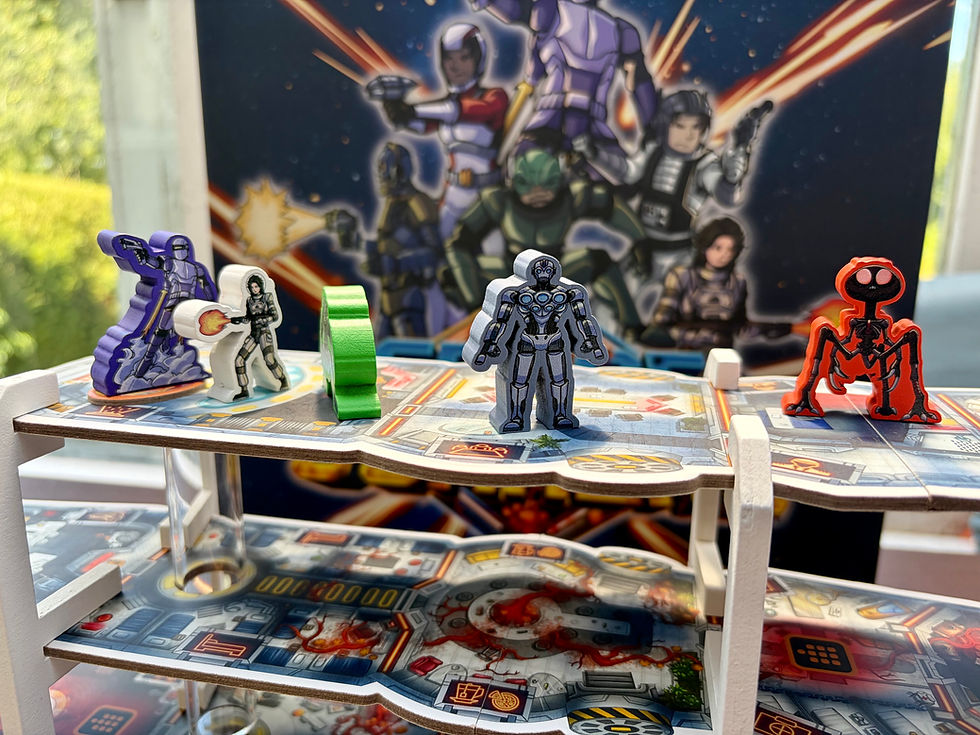
The first thing you notice is the ship. Space Junkers uses a three-tiered 3D board, with different decks stacked above each other to create the interior of the Deep space Horizon. It is instantly eye-catching. This is not a flat board pretending to be a spaceship. This looks and feels like something you are exploring.
Players each choose a character, (two each in a two player) and each character has their own asymmetric ability. The art is bright, colourful, silly and full of personality. Some characters may also remind you, completely coincidentally I am sure, of famous sci-fi faces from film and TV. Each player also takes their own board, action dice, reputation marker and starting pieces.

Salvage tokens are placed around the ship, the alien starts lurking somewhere unpleasant, the event deck is prepared, and players begin outside the ship. That last bit matters. Everyone is not just racing to collect loot. They are racing to get inside, pick a route, use the lifts, dive through airlocks, and work out where the best opportunities might appear before someone else beats them to it.

Missions can also be added, giving each player a specific place on the ship to head too, and I would recommend playing with them from the off, they are great! They give players extra objectives and make the game feel more personal and cinematic.
Space Junkers Board Game Preview - How To Play
Each round begins by establishing the first player. On the first round, this is the youngest player. After that, it is the player with the fewest salvage tokens, which is a nice catch-up touch that keeps people involved even when they have had a rough round. In a two player, just rotate it round.
Everyone rolls three action dice, although that number can drop if your reputation gets too low. The scum of the earth roll less dice. Then each player secretly chooses one die and locks it in. Once everyone is ready, all dice are revealed at the same time.

That chosen die determines what you can do this round. You may get movement, the ability to move the alien on board the ship with you, a wild action that can be used for movement or salvage, a ship system action, healing, and crucially your combat rating for the round, which will be one to six. The lower your rating, the more actions you can do.
What you choose may not always work out as planned because players before you may do things to stop your plans. But the lovely part is that you can resolve the symbols in any order. That gives every turn a small but satisfying puzzle rather than the often annoying dead turn seen in other programming games. Can you move first, grab salvage, then use a room effect? Should you shove someone away before they can act? Can you reach the airlock and trigger something horrible? All fun and often hilarious choices!
The ship systems are some of the most entertaining parts of the game. From the bridge, you can steal salvage previously collected by other players. From the med-bay, you can recover reputation. From engineering, you can activate the airlocks and blast players out if they happen to be standing in the wrong place. This is a game where positioning matters, but also a game where your position is never quite as safe as you think. And again, its often hilarious!
Combat is optional, but always present. Your chosen die gives you your combat rating for that round, so sometimes you are quick and slippery, and sometimes you are better prepared for a fight. If you attack successfully, by moving into a room with another player with a lower combat score than you, you can gain reputation and move your opponent to another room. Scuppering their plans and lowering their own reputation in the process. A double whammy! That movement can be the real prize. Pushing someone away from loot is good. Pushing them towards an alien is better. Pushing them into a situation where the ship itself finishes the job is chef’s kiss chaos. There can be some real chaos combos here. And, yes, you guessed it, its often hilarious!

At the end of each player’s turn, they update their salvage total and draw an event card. These events can change the board state, bring in new threats, drop more salvage, activate the security bot, or generally make everyone rethink their plans. The game ends when the salvage runs out or the event deck is exhausted, with players scoring salvage, completed mission bonuses, and adjusting based on reputation.
A ship worth boarding
The 3D ship is the immediate star. It looks brilliant on the table and gives Space Junkers a real toy-factor charm. You are moving through decks, using lifts, slipping through airlocks and watching trouble unfold above and below you. It helps sell the fantasy in a way a normal board simply could not.
There is a small practical downside. Because the ship is stacked, it can sometimes be fiddly to get your hands into certain areas without nudging pieces elsewhere. That may improve with final production, and it was never enough to ruin the game, but it is worth mentioning. The table presence is fantastic, but it does come with the usual 3D board trade-off: it looks amazing, and occasionally your fingers feel like they are performing surgery in a phone box.
The artwork also helps a lot. It is bright, vibrant, playful and full of comic sci-fi energy. The characters are fun, the world is instantly understandable, and the whole thing leans into the ridiculousness rather than pretending to be serious space opera. This is not solemn sci-fi. This is “grab the shiny space junk and try not to get eaten.”

One die, many problems
The dice selection is clever. You only choose one die each round, but that one die does a lot. It gives you actions, flexibility, possible combat strength, and sometimes access to powerful ship systems. Because everyone chooses secretly and reveals at the same time, you are never fully sure what the board will look like by the time your turn comes around.
There is a little Colt Express-style feeling here. You may plan to move into the next compartment and grab a lovely bit of valuable salvage, only for the player before you to wander in first and take it. Or move the alien. Or push you somewhere awful. Your plan is not happening in a vacuum. It is happening on a collapsing spaceship full of greedy idiots.
That makes turns quick, but keeps you invested when other players act. You are always watching. You are always adjusting. You are always hoping the player before you does not ruin everything. They often will.
The good chaos
After your turn, you will draw and act out an event turn. These cards are one of the best parts of the game. They make the ship feel unstable and alive. In our first game, we were down to the final salvage token. Rather than grab it which is one way you can trigger the end, and final round, we started avoiding it for a few turns, trying to finish missions and squeeze out extra points elsewhere. Then an event card suddenly dumped a load more juicy salvage onto the ship, completely changing the state of the game.
That was brilliant. It created a proper story moment. The issue is that once you have seen that card, you know it can happen. The event deck in the prototype felt like it could use more variety. I wanted more surprises, more weird ship malfunctions, more “oh no, not that” moments. The system is strong. I just wanted more of it. I think the game would be a lot better with more cards so you don't always see the same ones, just in a different order.
The same goes for some of the balance. The character powers are cool and give everyone a slightly different flavour, but some felt more immediately useful than others. That may well be adjusted before the final game, and it is exactly the kind of thing prototypes are for. But as played, a few powers seemed easier to exploit, while others felt more situational.

Missions need a little more love
My biggest question mark is around missions. I like them a lot in theory. In fact, they were probably my favourite way to play. They make the game feel more thematic and give you a reason to do something beyond hoovering up space trash as quickly as possible.
The problem is that salvage currently feels like the main and most efficient route to points. Completing missions is more fun, more involved and more story-driven, but it can feel like a lot of effort for less reward. If I have read the rules correctly, you only score a mission if you fully complete it. That means you could complete three out of four tasks and get nothing, which feels harsh.
I would love to see missions use a sliding scale. Give players something for partial completion, then a bigger bonus for finishing the whole card. That would make them feel less punishing, while still rewarding players who fully commit.
There was also one late-game token worth 1000 points that created a huge swing. You can steal it through combat, so there is counterplay, and I do love the jeopardy it brings. But if it appears late and there are only one or two turns left, that is a massive points shift that may come down to whether anyone has the right dice at the right time. Exciting? Definitely. Potentially too much? Also yes.

Final thoughts
Space Junkers is fast, funny and packed with memorable moments. It has a wonderful table presence, quick turns, bright artwork, lively interaction, and just enough tactical planning to stop the chaos from feeling empty. You can sneak, race, fight, steal, heal, shove, sabotage, and occasionally send someone into space, which is always fun unless it happens to you.
It still feels like a game that may benefit from some tuning. I would like to see more event cards, a closer look at mission scoring, and some balancing around character powers and big late-game swings. But the core is already strong. The 3D ship is not just a gimmick. It genuinely makes the game more engaging. The dice system keeps things moving. The player interaction creates stories. And the whole thing has that lovely “remember when you pushed me into the security bot?” energy that good chaotic games need.
Space Junkers will not be for people who dislike take-that, randomness or having their carefully planned turn ruined by another player. But for families, casual gamers, sci-fi fans and groups who like loud, interactive games with plenty of table drama, there is a lot to enjoy here.
In space, no one can hear you scream. Around this table, everyone absolutely can.


