

The Lost Island Roll and Write Preview
- Jim Gamer

- Apr 20
- 5 min read
This is a preview copy sent to us for our early opinions. No money exchanged hands. Some art, rules or components will change in the final game. Find out more here.
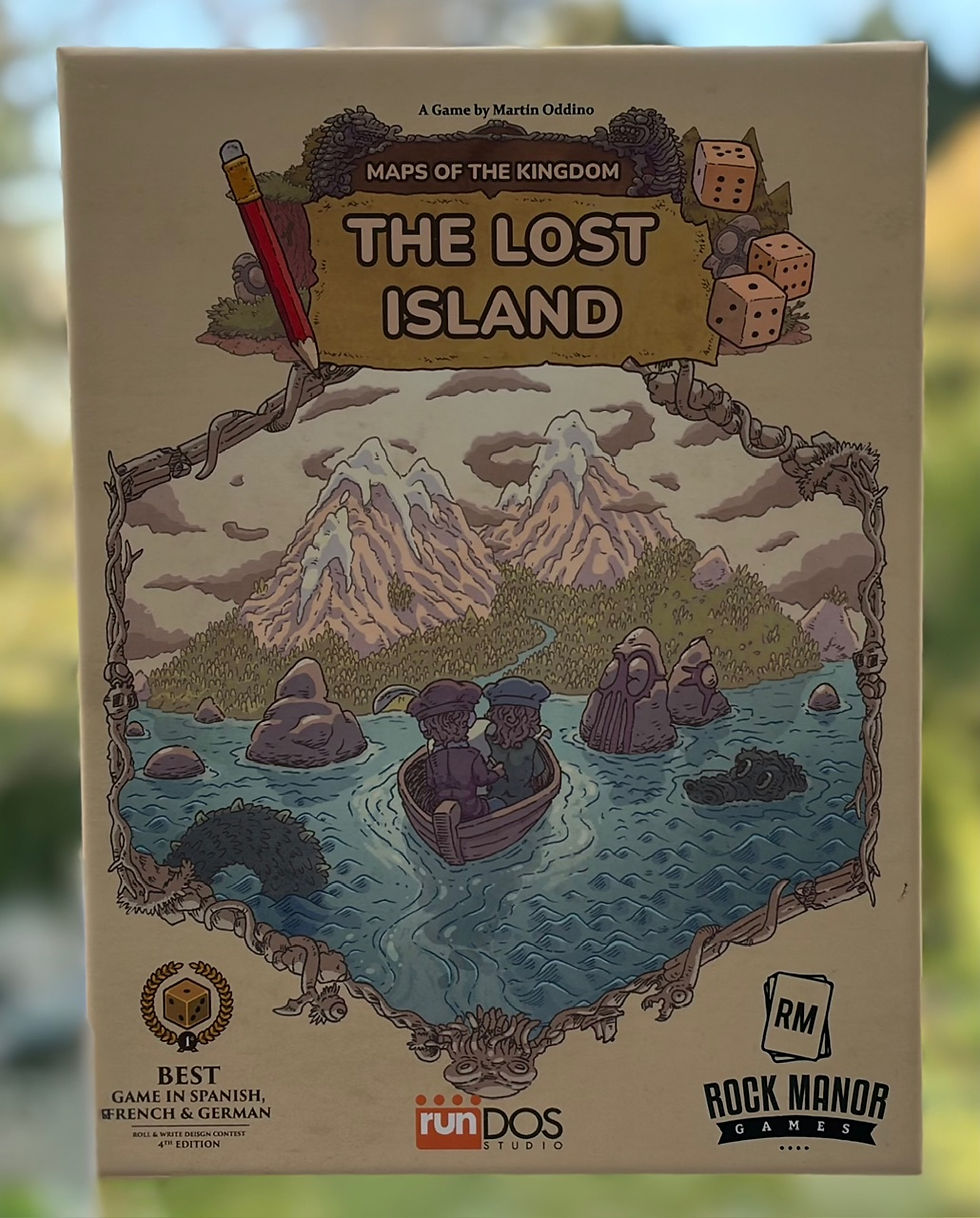
We recently previewed The Secret Valley, a lovely compact spatial card game that is coming to Kickstarter soon. Well, with that release, another game from the same publisher and designer is being crowdfunded at the same time. The Lost Island. The Lost Island is a classic looking and playing roll and write that first published in 2021, but is now seeing a more widespread release.
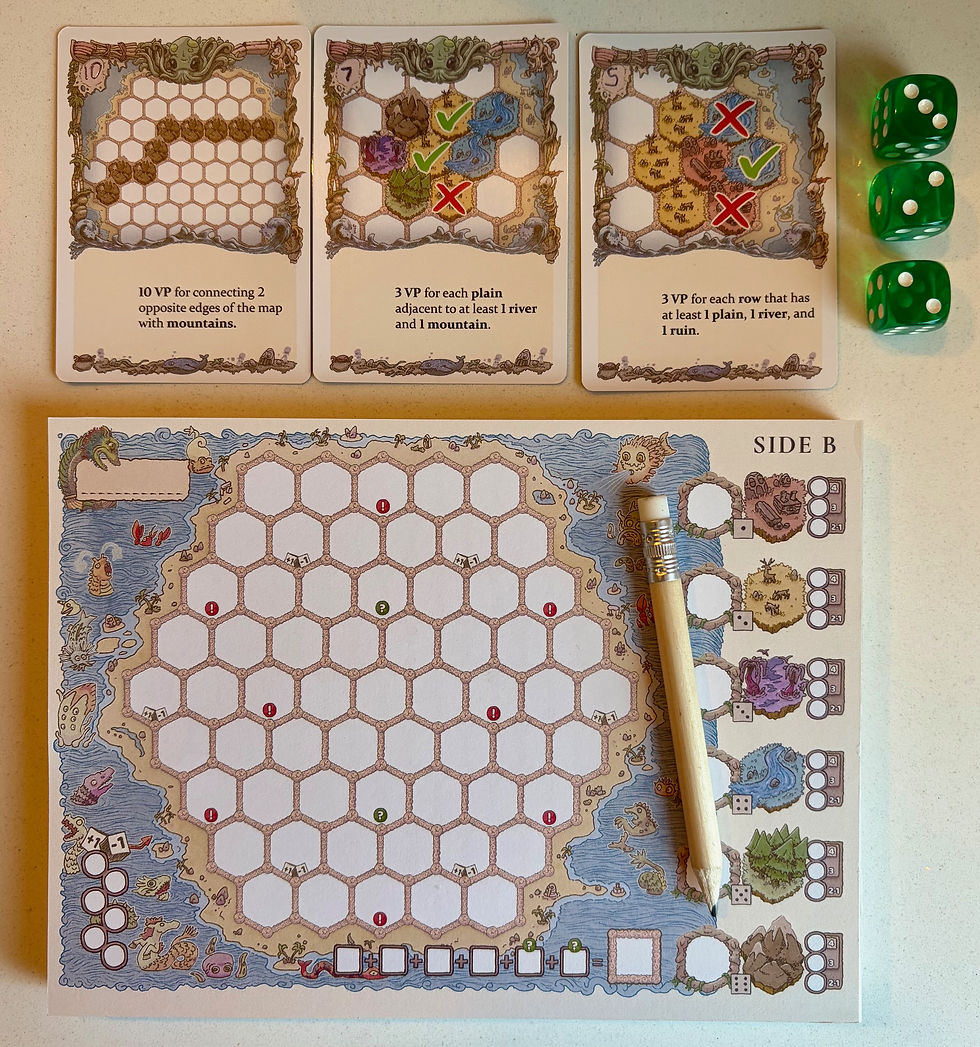
The game plays incredibly simply and fast. Give each player a playing sheet and a pencil. All players must decide to play on either side A or B, but they must all use the same side. Next, place the three dice down in the middle. Now, choose four scoring cards to use. Then have each player decide how they want to draw each of the five different territories in the game by sketching their chosen shape in the space for each on the right of the player sheet. Set up is done!
The first player now rolls all three dice. They then choose one of the five territories that all players will now draw. They cross off their chosen territory on their game sheet. Only they do this. They then choose one of the rolled dice. This determines how many of the chosen territory they draw on their player sheet. They can draw the first territory anywhere on their sheet, but any additional ones drawn that round must touch another drawn that round.
The other players then do the same, but with one of the two remaining dice, drawing that many of the same territory. Each player can choose any of the remaining two dice, even the same one if they wish. The lead player then moves round one space, and the three dice are rolled again.
Each territory can only be selected by the lead player once in a four player game. So four times in total across the game, as each player can choose it once. In a three player game there are two uses each. And in a two player game there are three uses each.
You will be drawing the territories based on the cards you chose during set up, and their specific scoring conditions. Points are awarded based on each territory’s alignment and placement with others, the size of groupings, or connections on the map, etc. All the standard scoring you would expect from this sort of spatial puzzle. But the combination of the four cards chosen, from a possible 12, means there is a huge amount of variation in how the game can play out, and the tactics you need to employ.
The game continues until either the active player runs out of uses of any available territory, or one or more players cannot draw the number of territories selected due to their player sheet running out of space. Players then score for each of the four chosen scoring cards, and the highest score wins.

On the player sheets, there are a few icons that affect the game. On side A, there are six spaces that let you mark off a plus or minus one modifier. When you draw any territory in one of these, mark off one of the spaces shown on the bottom left. Then, on any later turn, you can reduce or increase any die by one or more by crossing off the appropriate number of spaces.
There is also one question mark in the centre space. When you draw any territory in this space, you immediately score your current lowest scoring card from the four in play. This is a little laborious, as you need to work out all four scores and then take the lowest. But it is a good opportunity to see where you stand and whether you need to adjust your strategy. The point at which you choose to cover this central space is up to you, but the later you leave it, the higher you are likely to score.
On side B, there are two of these question marks. There are also eight exclamation marks. Whenever you are about to draw in one of these spaces, you can ignore the chosen territory from the lead player that turn, and instead draw any territory you wish.
The solo game works in the same way, with one small change. You roll three dice and pick one to draw that many of any chosen territory. You can draw each territory three times. Then, roll the remaining two dice. You must use one die to determine the territory type. You will notice each territory on your player sheet is marked one to six. The second die then determines how many of that territory you draw. You can choose which die does which, unless of course you roll a double.

The Lost Island is one of those roll and writes that knows exactly what it is doing. It's quick to teach, quick to play, and gets straight into the puzzle without any faff. What stands out immediately is how clean the turn structure feels. Roll, choose, draw, move on. There is almost no downtime, even at higher player counts, and that keeps everyone engaged from start to finish. It is not trying to reinvent the genre, but it absolutely delivers a smooth, satisfying loop.
What really carries it, though, is the scoring card variety. Across a couple of plays, the feel of the game shifted noticeably depending on what cards came out. One game had me tightly clustering shapes to chase adjacency bonuses, while another had me spreading out more cautiously to avoid blocking future placements. That moment halfway through, where you realise one scoring card is lagging badly and you need to pivot, is where the game finds its tension.
Who it is for and how it scales
This is very much a “bring it anywhere” kind of game. It works across two to four players without much drop-off, and the shared turn structure means everyone stays involved. It is particularly good for groups that enjoy spatial puzzles but do not want heavy rules overhead. The solo mode also deserves a nod. It keeps the core decision space intact with a clever dice tweak, rather than feeling like an afterthought.
That said, if you are looking for something deeply strategic or wildly innovative, this may feel a bit familiar. It sits comfortably alongside other roll and writes rather than trying to outdo them. The icon spaces and modifiers add some spice, but the core experience is still rooted in well-trodden territory.

Where it shines and where it stumbles
Pros:
Fast, clean gameplay with almost no downtime
Strong variability from scoring card combinations
Accessible rules with a satisfying spatial puzzle
Cons:
Does not push the genre in new directions
Scoring triggers can briefly interrupt the flow
Can feel a bit samey across repeated plays without card variety
Final thoughts
The Lost Island is a confident, well-executed roll and write that does all the fundamentals right. It is easy to get to the table, easy to teach, and offers just enough tactical flexibility to keep things interesting across multiple plays. It will not replace your heavier puzzlers, but it absolutely earns its place as a reliable, portable option that you can pull out with almost any group.
Sometimes you do not need to discover new lands, just enjoy mapping the ones you already know.
Deep huh!?


