
.png)
Roller Disco Card Game Preview

This is a preview copy sent to us for our early opinions. No money exchanged hands. Some art, rules or components will change in the final game.
Roller Disco comes from husband and wife team Joss & Mike, based in the UK. They successfully crowdfunded their first game, Sakana Stack, back in October 2024. And are now back for another spin!

Roller Disco throws players headfirst into the dizzy world of roller skating and card play. It’s a fast, light, ladder-climbing card-shedding game where the goal is simple: be the first to get rid of all your cards.
The game begins by dealing eight cards face up around the central disco ball. All remaining cards are then dealt evenly to the players, with certain cards removed at lower player counts to ensure everyone always starts with a similar-sized hand. Each player also receives one wild Jam card, while the remaining Jam cards form a separate draw pile.

Before play begins, each player has a single opportunity to swap one card from their hand with one of the eight face-up cards around the table. The dealer then places the roller skate boot standee, choosing both its position and the direction it faces. The card next to the boot is discarded, creating the first empty space.
On your turn, you must choose one of two actions: Pass or Skate. If you pass, you draw one Jam card into your hand. If you skate, you decide whether you’re Moving On Up or Getting On Down, meaning you’ll be playing cards that are either higher or lower than those already in play.
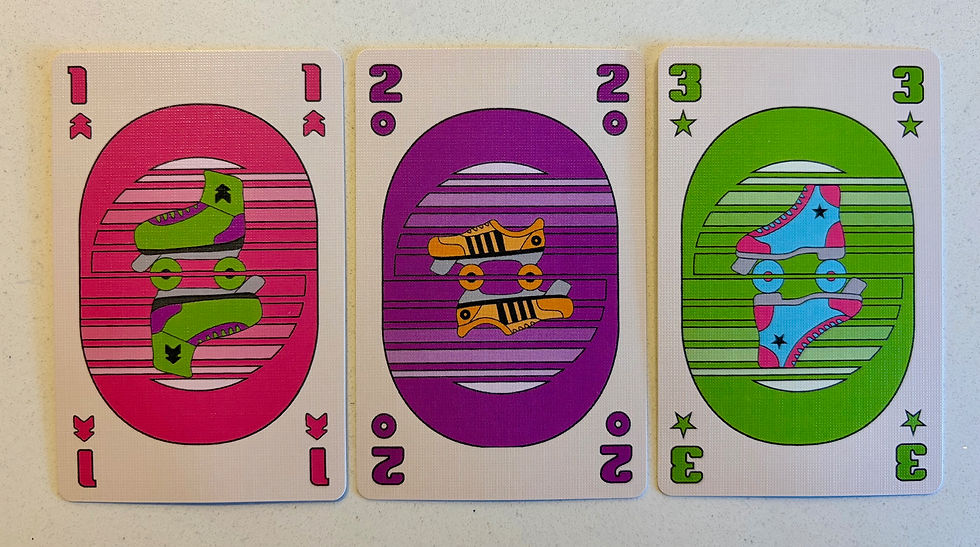
Starting from the boot and following its direction, you place a card into the first space. You may then continue placing cards on top of existing ones, as long as they match the suit and are strictly higher or lower, depending on your chosen play. You can keep skating until you can no longer legally play a card.
When that happens, you take the next card from the track into your hand and move the boot standee to that position, setting up the next player’s turn.
The first player to empty their hand wins. Simple, speedy, and full of disco momentum.

Why this works
Roller Disco succeeds because it blends familiar ladder-climbing mechanics with a strong sense of movement and table presence. The rotating boot, shared central track, and choice between playing higher or lower give players meaningful decisions without slowing the game down. Turns are quick, interaction is constant, and the satisfaction of skating “just one more card” creates natural tension and excitement, with players never quite knowing when the game will end. Players can have an elongating turn and end the game quickly, without your awareness or pre-planning, which can be frustrating, but great fun when you do it yourself.
Why it might not
Players looking for deep strategy or long-term planning may find Roller Disco too light. Much of the experience is driven by hand management and timing rather than complex combos or tactical engines. As with many card-shedding games, the luck of the draw can occasionally swing momentum, which may frustrate those who prefer tighter control.
Who will like it
This is a great fit for families, casual gamers, and groups who enjoy fast-paced, interactive card games. Fans of similar games like Scout will feel right at home. It also works well as a filler or opener, especially for groups that enjoy lively table talk and shared moments.
Who may not
Heavier strategy gamers, or players who dislike hand-shedding games altogether, may bounce off it quickly. Groups that prefer low interaction or purely multiplayer-solitaire experiences may also find the constant competition for table space less appealing.

Pros
Fast to learn and play
High player interaction
Clear decisions with high end-game tension
Strong theme that comes through in the gameplay
Scales well across player counts
Cons
Limited depth for repeated plays in quick succession
Some swinginess from card draw
May feel too light for strategy-focused groups
Roller Disco is a lively, approachable card game that does exactly what it sets out to do. It’s quick, interactive, and full of momentum, making it an easy recommendation for casual groups and families. While it won’t replace deeper card games in a regular rotation, it earns its place as a fun, energetic filler that keeps everyone engaged from start to finish.


