

Yield Board Game Review

WBG Score: 8
Player Count: 2-5
You’ll like this if you like: Texas Hold-em and The Gang
Published by: BFF Games
Designed by: Satoshi Matsuura, Luigi Sampieri Rodriguez
This is a free review copy. See our review policy here
Some games impress on first play and then slowly disappear from your thoughts. Yield has done the opposite for me. I enjoyed it when I first previewed the prototype, and after more plays over a much longer period, and now with this final print copy, I still enjoy it just as much. That matters, because this is exactly the sort of game where the real test is not whether the first few battles feel exciting, but whether the system still has enough life in it once you understand the tricks.
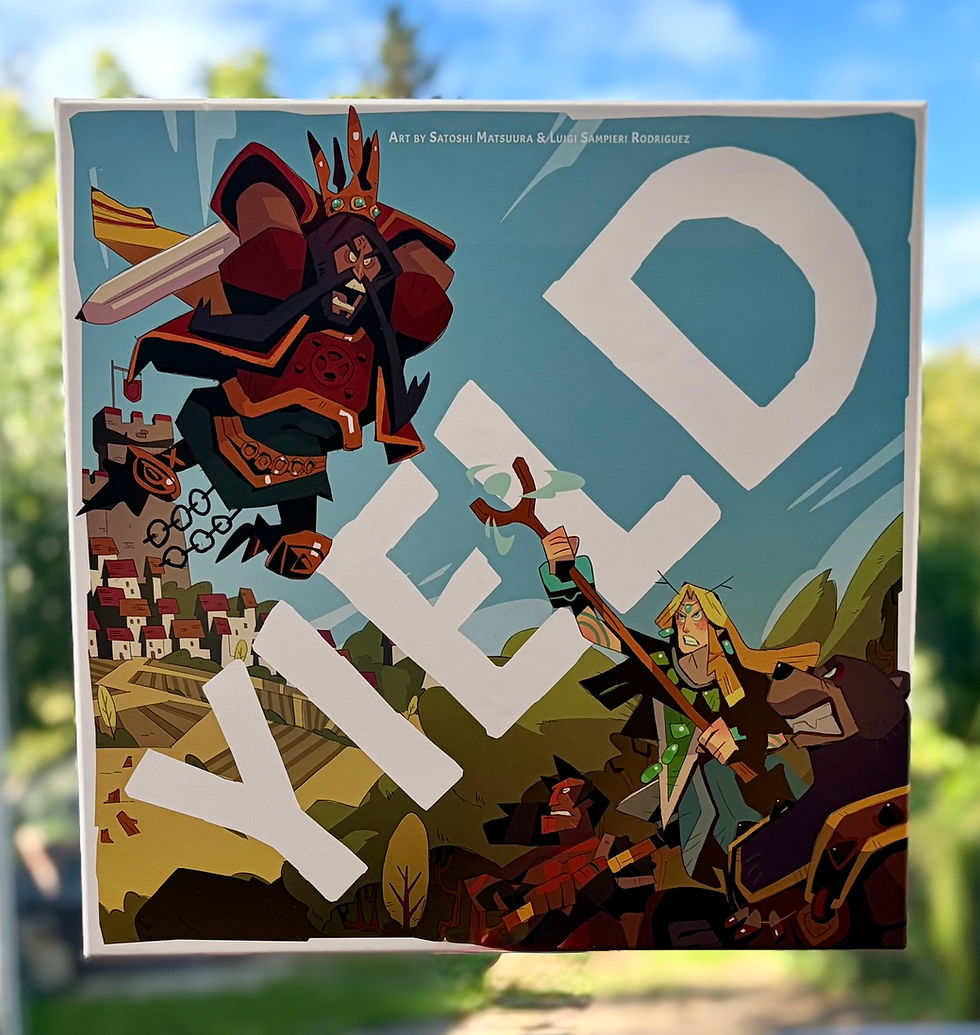
Set 43 years before the events of Hidden Leaders, Yield puts players in charge of rival Houses fighting for control of Oshra during a civil war. You move Armies around the map, strengthen and conquer Fortresses, manage hidden Army strength, and fight over the most valuable parts of the board. After three Years, each Fortress is worth the number of tokens in its stack, and whoever controls the top token scores the whole value.
Setup and How to Play
Each player begins with three Armies and secretly divides 12 Units between them, with at least one Unit in each. That hidden information immediately gives the game some tension, because the Army sitting next to you might be barely hanging on or could be far stronger than it looks. Players also start with six identical Strategy cards and a hand of Battle cards, while the map changes depending on player count.
The game lasts three Years, and each Year is divided into a Strategy phase, Battle phase, Conquer phase, and Recovery and Recruitment phase, although the final Year skips that last step. During the Strategy phase, players simultaneously choose one Strategy card, reveal them, and resolve them in turn order. This happens four times per Year, meaning you only play four of your six available Strategy cards before moving into battle.
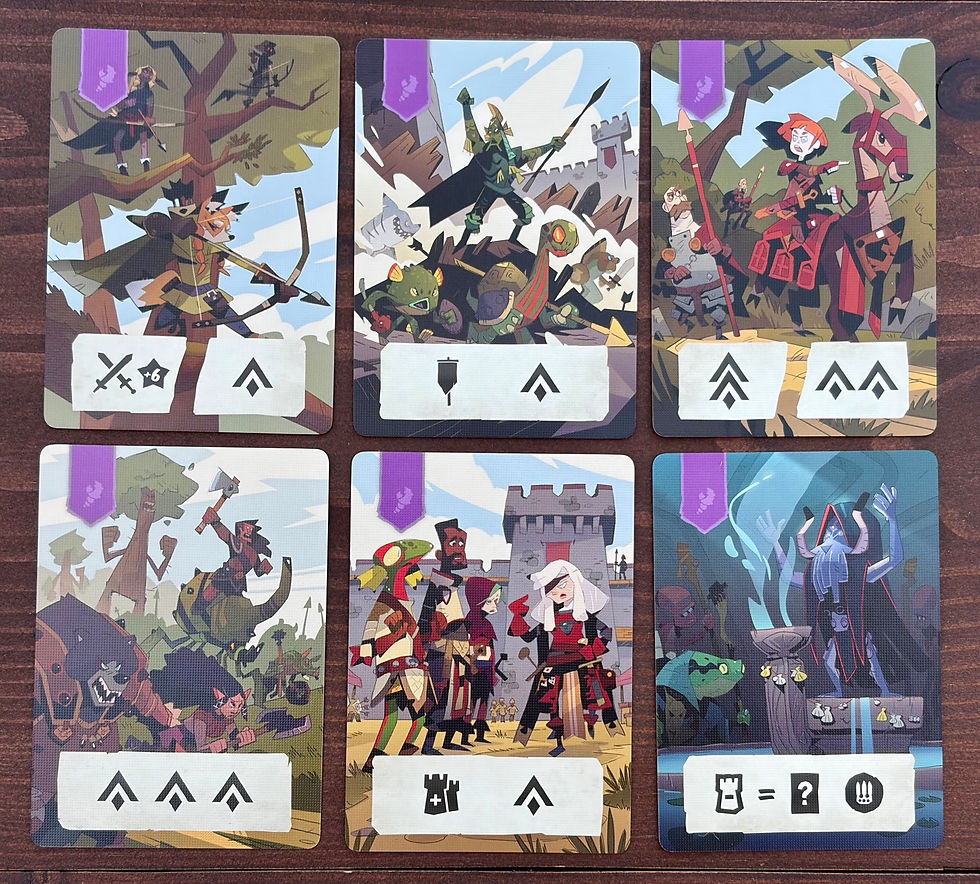
Those Strategy cards are refreshingly direct. They let you move, conquer unguarded or neutral Fortresses, ambush, upgrade Fortresses you already have, or use the Ritual card to sacrifice some Fortress value in exchange for copying another action and potentially changing the starting player. The decisions come less from having dozens of options and more from choosing exactly when to use the few tools you have.

Fighting for Oshra
Combat is where Yield really earns its name. When opposing Armies are adjacent, players reveal the strength of the participating forces and mark the totals on the Battle tracker. The weaker player gains initiative and must decide whether to play Battle cards to climb above their opponent, accept a draw where possible, or simply Yield and take the loss.
Battle cards are tied to the colour of the region your army occupies, so positioning matters before the fight even starts. Matching cards can be played face up for their full value, while any card can be played face down for just one point. This creates some lovely tension because you are constantly asking whether your opponent genuinely has the cards to keep going or is simply trying to make you blink first. You can play as many cards as you wish until you have a higher score. Then the other player takes the initiative and can do the same in return if they wish and have the cards to do so. This continues until one player yields. Get the name now? Although you can tie and draw too.
Losing does not necessarily mean destruction. You lose Units equal to the difference between the two sides scores after adding all battle cards played, then retreat, while the winner may Chase into the vacated position. Armies can also be destroyed if they hit zero or have nowhere legal to retreat, and doing so grants the victor free Fortress upgrades. This makes battles meaningful without turning every defeat into a complete disaster.

The Fortresses Are the Real Prize
The most interesting part of the scoring system is that Fortresses become more valuable as players interact with them. Every time one is conquered, another token is added to the stack, increasing its value for whoever eventually controls it. They score one point per token there at the end of the game. And tokens never go away; they don't get removed. They just get added to as the game progresses. That means a location can become increasingly tempting as the game goes on, and a Fortress everyone has been fighting over can suddenly be worth far more than something you quietly protected in a corner.
This creates some excellent late-game pressure. I have had games come down to one final battle over one heavily upgraded Fortress, with everything resting on positioning, hidden Army strength and whether the right Battle cards are still in hand. That is exactly the sort of finish I want from a fast area-control game.
It also means Yield is less about building an empire you defend forever and more about timing. Control can be fluid, and that will not suit everyone, but I like the way it keeps players moving and interacting. Sitting safely in one corner is rarely the most rewarding route.
Where the Game Really Comes Alive
The asymmetric Leaders remain my favourite part of the design. Each offers two different powers, and some of them dramatically change how you approach the board. Keralon can field a fourth Army or strengthen Battle cards through a Champion, Lemron can move or even create Fortresses, Vymar can improve face-down Battle cards, and Pavyr can gain power from Fortresses or steal cards.
Then there is Basil. One side lets losing Armies gain Units rather than lose them, while the other can win the entire game immediately by destroying a single enemy Army. That sounds completely ridiculous on paper, but powers like this are exactly what give Yield its character and make different match-ups feel meaningfully different. I adore it!
Importantly, that variety has held up for me. This is not something I only enjoyed during the excitement of the prototype. More games have simply reinforced how much I like exploring different powers, different maps and different ways of approaching the same compact system.

What Might Not Work for Everyone
There are a few areas where I can see players bouncing off the game. The battle system is intentionally incremental, with players leapfrogging each other by playing cards until one side finally gives in. And you can have your arsenal of battle cards drained with one battle, when your plans were to use them for something else. I enjoy that tension, but if you prefer combat to resolve quickly and decisively and with a little more control, the back-and-forth can feel repetitive. Worse n a multi-player game of more than two, when you are not involved in a long back-and-forth battle.
The game can also feel quite fluid for an area-control title. With only three Armies, holding everything you capture is difficult, and Fortresses can change hands repeatedly. If you like building secure borders and carefully defending territory, this may feel less satisfying than a more traditional conquest game. This is a fluid game.

Pros
Fast, punchy area control with meaningful interaction.
Excellent asymmetry that keeps different match-ups fresh.
Clever hidden Army strength and Battle card tension.
Strong replayability despite a relatively focused ruleset.
Cons
Battles may feel repetitive if you dislike incremental escalation.
Territory can be hard to hold, especially at higher player counts.
Multiplayer battles are slightly more cumbersome than the rest of the game.
The core loop is focused rather than mechanically broad.

Final Thoughts
When I first previewed Yield, I thought it had the potential to be a very good fast area-control game. Now, after considerably more time with it, I am more confident in that judgement. The initial excitement has not worn off, and the game still gives me the same satisfying mix of bluffing, positioning, tactical aggression and dramatic late battles.
What impresses me most is how much game it gets into a relatively short playtime. You are constantly making meaningful decisions about where to move, which Strategy card to commit, when to risk a battle, when to Yield and which Fortresses are worth fighting for. The asymmetric powers then push those decisions in different directions without turning the game into a sprawling rules exercise.
Most importantly, Yield is still a keeper. I have had enough time with it now for the novelty to disappear, and I still want it on my shelf and still want to play it. For me, that is about as useful a recommendation as any review can give.


