
.png)
Trials of Maya Preview: Big Box, Big Ideas, Big Potential

Updated: Sep 8
This is a preview copy sent to us for our early opinions. No money exchanged hands. Some art, rules or components will change in the final game. Find out more here - this is an affiliate link. Meaning that if you click on this and then pledge for the game we will get a small fee paid to us in return.
There are games that arrive with a clear pitch, and then there are games that arrive looking like the opening chapter of something much larger. Trials of Maya is firmly in the second camp. This is a bright, ambitious, card-driven arena battler set inside a wider narrative universe, and even my preview copy came with a novel set in the same world, featuring the same characters and mythology. It immediately gives the impression that the board game is only one part of what Department of Lore wants Maya to become.

That ambition is visible everywhere. The box is huge, the artwork is bold and colourful, the characters are highly distinctive, and there is a lot going on before you have even moved your first miniature. It can initially feel intimidating, but underneath all that terminology, iconography and world-building is a surprisingly clean tactical game built around a very clever card system.
Welcome to Maya
In the fiction, Maya is a sentient network designed to predict fate. Every person in the world of Neh is connected to it, and Maya runs endless simulations, or Trials, using echoes of legendary Champions pulled from different timelines. Every battle, victory and death becomes another data point in its attempt to understand causality and predict what happens next.
That framing works particularly well because it explains why Champions can repeatedly die and respawn without the game having to wave away the contradiction. It also gives the whole thing a strong videogame flavour without simply pretending the tabletop experience is something it is not. The world feels deliberately designed to support repeated arena combat, multiple characters and future expansion.
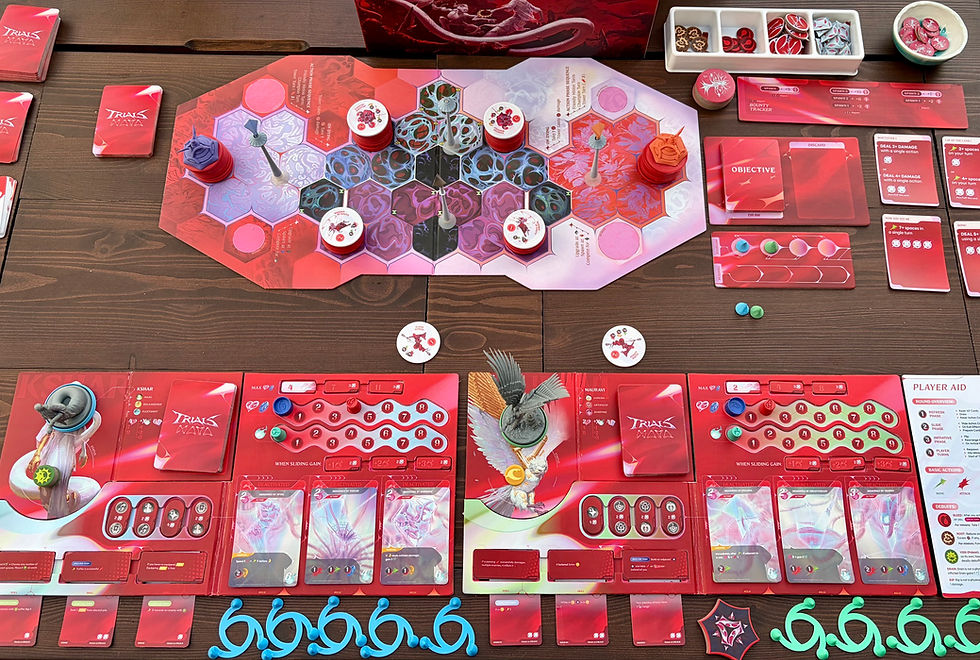
And expansion certainly feels like part of the plan. Even within the core game, Champions have species and class traits, unique abilities, starter decks, upgrade paths and different tactical identities. The wider universe then gives all of that somewhere to grow, which makes Trials of Maya feel less like a one-off box and more like the start of a system.
Cards on a Conveyor Belt
The best part of Trials of Maya is the card system. Each player has three Action Cards sitting across their player mat, and at the start of every round those cards slide one space to the right. The card leaving the far side is discarded and generates energy, while you add a new card face down into the newly empty left-hand slot.
Then everybody reveals their new card simultaneously. The card with the lowest eventual energy gain gives its player the best initiative, so you are constantly weighing future resources against acting earlier now. That is a wonderfully simple decision with a surprising amount of tactical depth because the card you choose affects not only your current options, but also future turns and future energy.
Once it is your turn, you spend energy to activate cards already sitting on your mat. You can use the actions on that card in any order, but once you activate another Action Card, you cannot return to unfinished actions on the previous one. That creates some genuinely satisfying sequencing puzzles without bogging the game down in excessive admin.
And this is where Trials of Maya really surprised me. You can have a lot of options available to you, but turns remain quick and snappy. You might move, attack, defend, push an enemy into a wall, trigger a passive ability, equip a Relic or play a Spell, yet the structure keeps all of that moving forward rather than turning every activation into a 15-minute think.

Fighting Smart
Movement takes place across a hex-based arena, and positioning matters. High ground adds extra attack damage, walls block movement and attacks, spikes hurt anyone moving through them, and Void spaces are completely impassable.
The actions themselves are straightforward. You can Move, Attack, Defend, Draw, Pull and Push, with modifiers adding range, projectiles, piercing attacks and area effects. Push in particular is good fun because smashing someone into terrain or another unit can cause collision damage, making positioning an offensive weapon rather than simply a means of getting within range.
This is also where the Champion asymmetry starts to shine. Some characters are better at taking punishment, others thrive on mobility or explosive damage, while some want to build around specific traits and card combinations. Playing efficiently means understanding not just what your cards can do, but what your particular Champion wants those cards to become.

Level Up Your Trials of Maya
The other major system is progression. Objectives sit beside the arena and reward XP for completing specific feats during your turn, but each Champion can complete only one Objective Card per round. If you are first to complete a non-starter objective, you receive its full reward, while subsequent players generally get a reduced pay-out.
XP can then be spent at Upgrade Points to improve your Champion. You can increase maximum health, improve future energy gain, unlock additional trait symbols, or unlock and upgrade Champion-specific skills. Those skills can eventually branch into one of two Level 2 versions, giving players some genuinely meaningful development choices during the game.
I really enjoyed this layer because it gives each match a sense of progression without feeling like a campaign game. You are not merely playing your Champion, you are shaping them as the battle develops. Two games with the same character can go in different directions depending on which objectives appear, what your opponent is doing and which weaknesses you decide need fixing.

Minion Business
Minions add another strategic layer. Neutral minions can be provoked by damaging them or simply ending your turn too close, at which point they retaliate. Kill one, however, and you can take control of it and later spawn it as an allied unit.
Even better, the damage you deal to minions becomes an HP bank that can later be used to bring captured minions back onto the board. This creates a nice little economy around deciding how heavily to invest in them. A captured minion can become another meaningful tactical piece, and suddenly you are no longer controlling just one Champion but an increasingly useful little fighting force.
It also helps Trials of Maya feel properly like a tabletop MOBA. Minions, objectives, levelling, map control, towers and respawning are not simply terminology borrowed from videogames. They are interconnected systems that genuinely affect how you approach the arena.

Pick Your Fight
There is plenty of variety in how you actually play. Siege can be played 1v1 or 2v2, while Headhunters provides a more free-for-all style experience focused heavily around minions and scoring. Different player counts use different arenas and structures rather than simply squeezing the same game into fewer seats.
That is important because it gives the box a sense of flexibility. If you primarily want a two-player tactical duel, there is a game for that. If you want team-based play or something more chaotic with additional players, there are options there too.
Then there is deck construction. Every Champion comes with a ready-made starter deck, which is absolutely where I would begin, but experienced players can build custom decks of between 24 and 40 cards using cards that share traits with their Champion or their unique Signature Cards.
That should give the game serious longevity for players who enjoy exploring builds. The starter decks teach you what each Champion is trying to do, while the wider card pool gives you the opportunity to bend that identity into something more personal once you understand the system.

The Wall Around the Arena
There is, however, a fairly substantial barrier to entry.
This is a big box with a lot inside it, and there is a significant amount of terminology and iconography to absorb. The actual game is nowhere near as difficult to play as the rulebooks initially make it appear, but you still need to learn what a large number of symbols, statuses, traits and effects mean before everything starts flowing naturally.
The good news is that Trials of Maya does an excellent job of supporting you. Player aids are genuinely useful, terminology is clearly referenced, and there is separate reference material available when you inevitably need to check exactly what something does. I found that answers were generally quick to locate, even if I was locating them fairly frequently during those opening games.
And that distinction matters. This is not a game where the fundamental mechanics remain confusing after multiple plays. Instead, the core loop becomes straightforward surprisingly quickly, while the challenge comes from remembering the vocabulary surrounding it.
It took me a while to properly settle into Trials of Maya. Once I did, however, the effort felt worthwhile.

Pros
Excellent card system that combines action selection, energy management and initiative in one clever mechanism.
Huge Champion variety, with meaningful asymmetry, upgrades and custom deck construction.
Fast, exciting turns despite players having plenty of tactical options.
Bright, vibrant production and world-building that makes Maya feel like the beginning of something much larger.
Cons
A substantial initial learning barrier, with plenty of symbols, traits, keywords and terminology.
Big box, big commitment, and this is clearly unlikely to be an inexpensive proposition.
The breadth of options means your first few games involve a fair amount of reference checking, even though answers are usually easy to find.

Enter the Arena
Trials of Maya is an ambitious game. In fact, ambition might be the single word that best describes the entire project. The designers have created a tactical arena battler, a deck-building framework, multiple game modes, highly asymmetric Champions and an entire fictional universe around them, then wrapped all of that inside a presentation that wants you to believe there is much more still to come.
Most importantly, though, the card play works. It is varied, exciting and surprisingly quick, giving you opportunities to pull off clever combinations without forcing everyone else to sit around while you do them. The sliding card system also gives Trials of Maya a genuinely distinctive tactical identity rather than making this simply another game of moving miniatures around an arena.
The question is whether you want to climb over that opening wall. If you want a lightweight fighting game you can unpack, explain in five minutes and immediately throw onto the table, this probably is not it. If you want a deep, card-driven fighting game with asymmetric characters, lots of player-count options, tactical development and what appears to be an entire future universe being built around it, Trials of Maya could potentially become something very big indeed.
And if that sounds like your sort of thing, there may be something rather appealing about getting involved right at the beginning. Check out more about the game here.
Preview copy provided free of charge with no obligation to provide positive coverage. This article is based on a pre-release version of the game, so components, rules and content may change before final publication. You can read our full review policy at WhatBoardGame.com.


