
.png)
Top 5 Garden & Beach Games

Updated: Sep 21
Which One Deserves Your Love?

Board games are wonderful, but every now and then the sun comes out, somebody lights a barbecue (when safe), and sitting around a table suddenly feels like a terrible waste of the sunshine. That is where garden games come in. The best ones keep the accessibility of a party game but replace cards and cardboard with throwing, aiming, catching and, occasionally, making yourself look ridiculous in front of the neighbours.
I have been trying a lot of very different outdoor games over the last few months to find the very best garden game and have narrowed down my favourites into a top 5: Bat & Trap, Cornhole, Rope Quoits, Canoff, and Mölkky. I have also included one other extra surprise honourable mention for more able garden gamers! Some are centuries old, some feel distinctly modern, and one surprised me by becoming easily my favourite of the lot. They all share one important quality though: you can explain them quickly, hand someone the equipment, and start playing almost immediately.
Masters Traditional Games kindly loaned me the Bat & Trap, Cornhole and Rope Quoits sets featured here, while Canoff supplied the Canoff crew for review. Mölkky and the other games I tried were my own sets, or ones I tried with friends. There was no obligation to provide positive coverage and, as always, these arrangements have had no knowing influence on my opinions. You can read our full review policy on WhatBoardGame.com. So, lets get playing and find out which are our Top 5 Garden & Beach Games. And from these, which is our favourite and the best garden game!
Bat & Trap
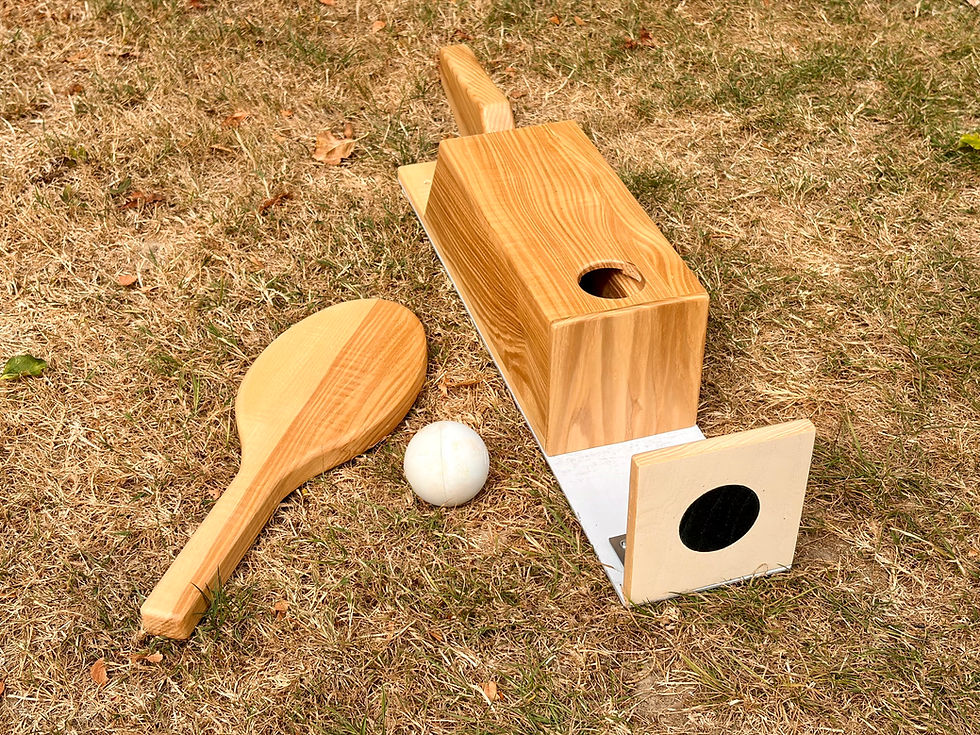
Bat & Trap feels like someone unearthed an old English pub game, polished up the wood, and dropped it straight into my garden. It is an ancient relative of cricket and, some say, the inspiration for the classic summer team sport. It has a wonderfully eccentric combination of batting, fielding, and bowling that immediately gives it more character than most modern lawn games. There is something enormously satisfying about playing a game with this much history using equipment that looks as though it belongs in an old village pub, but plays so well. It's proper craftsmanship.
How to set up
The centrepiece is the trap itself, a rectangular wooden mechanism placed at one end of the playing area. At the opposite end are two posts forming the target area, with the fielding team standing behind and between them. You will need to supply your own posts with most sets, but it really can be anything. Stones, twigs, chairs. Two grandparents! Whatever you want. And it's nice you can adapt the width to suit your preferences. Traditionally, the game uses teams of eight, with each player batting once and the team totally their score. Although in a garden there is absolutely nothing stopping you from adapting numbers, distance, and scoring to suit whoever happens to be available. We played one vs. one plenty of times.
The Masters Traditional Games Bat & Trap set I used is beautifully made.. The wooden trap is substantial, the mechanism feels reassuringly solid, and there are thoughtful touches designed to keep everything stable during play. It is the sort of object that looks good simply sitting around, although you will need somewhere sensible to store it because this is not lightweight garden equipment. It's pretty heavy, and you wouldn't want to just leave it out to become weather damaged. It's too nice!
How to play
The batter places the ball over the hole then strikes a lever on the trap, launching a hard rubber ball into the air, then attempts to hit that same ball with the bat towards the opposite end of the pitch. Get it through the target area and avoid a catch from the fielders and you survive the first part of the turn. Miss the target or send the ball directly into somebody's waiting hands and you are out.
Then comes the clever bit. A fielder returns the ball towards the trap, aiming at the small hinged black target on its front, and if they knock that wicket down the batter is bowled out. Miss it and the batting side scores a run, with the same batter continuing for another attempt.

Cricket's strange garden cousin
I really enjoy Bat & Trap because the two halves of each turn work beautifully together. Launching and striking the ball is satisfying, but then suddenly you are watching the ball bounce back towards a tiny target knowing your entire innings depends on the bowler missing it. It creates a surprisingly entertaining rhythm.
Distance also becomes an easy difficulty setting. Better players can stand further away, while children or less confident players can move closer, meaning the game adapts naturally without needing a complicated handicap system. Scoring and team sizes can be loosened up just as easily, which makes the traditional eight-a-side format far more practical for family play.
There are drawbacks. You need a decent amount of space, the equipment is large and heavy, and this is not something you casually sling over your shoulder for a walk to the park. It transports perfectly well in a car, but compared with most garden games this is very much a piece of proper equipment rather than a portable toy.
The hard rubber ball also has a personality of its own. On my less-than-perfect lawn it bounced around like it had somewhere important to be, making accurate returns considerably harder than they would be on flat ground. Rather than spoiling things, that unpredictability became part of the fun, although anyone expecting pristine sporting precision may want to mow the lawn first.
Pros
Beautifully crafted equipment with loads of traditional character.
Easy to adjust distance, scoring and team sizes for different players.
The combination of batting and bowling gives everyone something to do.
A wonderful history and story to tell.
Cons
Large, heavy and expensive compared with simpler garden games.
Needs a fair amount of playing space.
Enjoyable, but ultimately a little one-dimensional after repeated plays.
Bat & Trap is beautiful, unusual and steeped in history. It may not have enough depth to become an every-week obsession, but as something different to pull out with friends or family it has considerable charm.
Cornhole

Cornhole might be one of the most straightforward games here to explain, but there is slightly more lurking beneath the surface than throwing a bag towards a hole. Its popularity in America makes complete sense because this is exactly the sort of game that can sit alongside food, drinks and conversation without demanding everyone's complete attention. The problem is that the full-size version also occupies roughly the same amount of space as a small dining table.
How to set up
The game uses two raised wooden boards with a hole towards the far end, together with eight throwing bags. Players stand at the opposite end and take turns throwing their bags towards the board. The rules are simple enough that most people will understand what they are doing after watching a single throw.
The Masters Traditional Games Cornhole set is a full-size wooden version and it feels suitably substantial. Unfortunately, substantial also means very large and very heavy. Although it comes with a protective carry bag, I never really thought of this as something I would want to carry any meaningful distance. We mostly played this one in our own garden.
How to play
Get a bag through the hole and you score three points. Leave one resting on the board and you score one. Everything else scores nothing.
That sounds almost suspiciously basic, but the board creates the game's most interesting moments. Bags can skid across the surface, stop in front of the hole, knock earlier throws into scoring positions or interfere with an opponent's bags. Suddenly you are not only aiming for the hole but thinking about what your throw might do to everything already sitting there.
Bigger than expected in more ways than one
Cornhole is undeniably fun. Throwing games work because missing is funny, succeeding feels good and everyone can immediately tell whether you have just produced brilliance or embarrassment. The possibility of using one bag to shove another into the hole gives the game just enough tactical interest to keep things competitive.
My biggest issue is simply the physical product. These boards are huge, heavy and awkward to move, and whenever I carried them around I found myself worrying about damaging the wood. For a permanent garden setup, fête, fair or organised event that is not necessarily a problem, but it removes much of the spontaneous portability I normally associate with outdoor games.
The game itself also reaches its ceiling relatively quickly. There is skill in judging distance, angle and power, and the blocking possibilities add a welcome tactical layer, but fundamentally you will spend the evening throwing bags at the same board. Whether that is enough depends entirely on how competitive your group becomes.
Pros
Extremely easy to teach and immediately accessible.
Sliding and knocking bags creates more tactics than expected.
Excellent for relaxed social play.
Cons
The full-size wooden set is exceptionally bulky and heavy.
Awkward to move and potentially vulnerable to knocks during transport.
The gameplay can feel repetitive fairly quickly.
Cornhole is a good garden game trapped inside a very large piece of furniture. If you have the space and can leave it somewhere convenient, it is easy-going fun, but I would not choose it when portability matters.
Rope Quoits

Rope Quoits has perhaps the nicest origin story of the five games here. Sailors fashioned quoits from rope and threw them towards suitable targets aboard ships, with versions of the game later becoming familiar on passenger liners and cruise ships. There is something rather lovely about bringing that same simple activity into a modern garden.
How to set up
The Masters Traditional Games Deck Quoits set uses a wooden stake and rope rings. Set the target at whatever distance suits the players, divide up the quoits and you are essentially ready to begin. Like most traditional outdoor games, the exact scoring can be adjusted depending on how formal you want proceedings to become.
The set itself makes a strong first impression. The rope quoits feel pleasant in your hands, the wooden components look attractive and the whole thing suits a garden aesthetically far better than brightly coloured plastic equipment. It is also much easier to move around than either Bat & Trap or Cornhole.
How to play
At its simplest, players take turns attempting to throw their rope quoits over or as close as possible to the target. Different versions use different scoring systems, and traditional Deck Quoits itself has never been completely standardised. That informality suits the game perfectly because nobody is going to spend ten minutes debating the finer points before throwing a rope ring across the lawn.
And that is really all there is to it. You aim, you throw, you either celebrate or retrieve the ring and try again. The challenge is entirely about distance control and accuracy.
Lovely, but lightweight
I enjoyed Rope Quoits. The equipment feels nice, it looks good in the garden and there is something relaxing about repeatedly trying to land a clean throw. It is the kind of activity you can teach somebody in seconds and then casually play while chatting.
But there simply is not much underneath it. Unlike Cornhole, where bags can interact with one another, or Canoff, where the defending side remains involved, Quoits is largely just repeated target throwing. That is fine for a quick diversion, particularly with children or during a gathering, but it struggled to hold my attention for long.
Pros
Attractive, tactile equipment.
Exceptionally easy to teach.
Quick, relaxed fun for mixed groups.
Cons
Very little tactical depth.
Repetition arrives quickly.
Better as a short activity than a main event.
Rope Quoits is pleasant rather than compelling. I am happy to own it, happy to play it, and equally happy to move onto something else after ten minutes.
Canoff

Canoff was the game I expected the least from and enjoyed the most. When somebody explains that you are going to throw a flying disc at a can balanced on a pole, it does not exactly sound like years of development went into the concept. Or that you need the official set! Then you start playing and discover that this ridiculously simple idea produces laughter, spectacular misses, frantic catches, and constant involvement. And the official kit is wonderful.
How to set up
Two teams each have a pole with a can balanced on top, with the teams positioned opposite each other. Players stand at least one metre behind their poles during play, and one flying disc travels backwards and forwards between the sides. The whole setup is compact enough to work in a garden, park or on the beach.
Canoff supplied the set I used for this review. The format is much more portable than the larger wooden games in this feature, which immediately makes it easier to imagine taking somewhere rather than merely owning it at home. It all packs down into a small supplied mesh bag. That proved particularly useful when we played on the beach.
How to play
Players throw the disc towards the opposing team's can. Knock the can off cleanly and you score two points, while hitting the pole and causing the can to fall scores one. If the defending team catches the can after the pole is hit, however, the attacking side scores nothing. Knocking the can off after hitting the pole too low in the red zone also scores nothing.
There are additional opportunities for chaos. Knock your own can off by mistake and you lose a point, while bad throws or dropped catches can earn whatever penalty your group decides is appropriate. The official suggestion that players keep one hand behind their back, or hold a drink in it, tells you almost everything you need to know about the intended atmosphere.

Why is this so much fun?
The magic is that Canoff keeps both teams engaged. With a normal throwing game, the defending side mostly stands around watching someone else take their turn. Here, the moment that disc leaves someone's hand, the other team is preparing to react because even a poor hit can suddenly turn into a desperate attempt to catch a falling can.
Throwing a flying disc is already enjoyable on its own, but giving it a target makes every throw more interesting. You begin trying different angles and powers, while the defending side watches the flight knowing they may have to move instantly. The simplicity that initially made me suspicious turned out to be exactly why it works.
When we played on the beach, this was easily the game that attracted the most attention. People watched, laughed and clearly understood what was happening without needing any explanation, which is perhaps the strongest endorsement an outdoor party game can receive. It creates a spectacle without trying particularly hard to do so.
Most importantly, Canoff creates moments. A perfect direct hit feels brilliant, a ridiculous miss becomes funny, and a last-second catch can produce more celebration than it has any right to. Out of all five games, this was the one I most wanted to keep playing.
Pros
Constant involvement for both attacking and defending teams.
Brilliantly simple yet surprisingly exciting.
Portable, social and superb at creating memorable moments.
Cons
Disc throwing ability can create a noticeable skill gap.
Probably at its best with a lively, competitive group.
Canoff is the surprise package of the entire test. I expected a throwaway garden distraction and found the game I would most happily take to the beach, park or barbecue tomorrow.
Mölkky

Mölkky might be the smartest game in this group. The Finnish throwing game begins like a straightforward skittles challenge, but within a few rounds the pins have scattered across the playing area and suddenly every throw feels like a small tactical decision. It combines accessibility, skill and just enough arithmetic to make reaching the finish genuinely tense.
How to set up
Twelve numbered wooden pins are arranged tightly together, with players throwing from roughly three to four metres away. The throwing pin is tossed underarm towards them, making the basic physical action accessible to almost anyone. Younger children or less confident players can simply stand closer, which is an easy way to balance the game without changing anything else.
One warning though: give yourself more room than the initial setup suggests. The starting formation is compact, but the game will not stay that way for long. By the later rounds, the pins can be scattered surprisingly widely.
How to play
Knock down exactly one pin and you score the number printed on it. Knock down multiple pins and you score only the number of pins that fell, so flattening pins three, seven and 12 gives you three points rather than 22. After every throw, the fallen pins are stood upright again exactly where they landed.
That final rule transforms everything. Early on you can simply launch the throwing pin into a tightly packed group, but gradually individual numbers become isolated and awkward to reach. What begins as something resembling skittles evolves into a precision game where you are hunting specific targets.
Traditionally, reaching exactly 50 points wins, with different versions handling overshooting in different ways. I particularly enjoy playing a harsher variant where going beyond 50 eliminates you completely. It creates genuine tension late in the game because somebody sitting on 47 suddenly needs to find that isolated three and absolutely cannot afford to hit anything higher. We also play where if you miss entirely three times in a row, you are out. Just for more tension. (and it was in the rules that came with our friends version).
Simple rules, excellent development
I love Mölkky. It works brilliantly in a garden or on the beach because players understand the basic idea immediately, yet the changing board state means the challenge constantly evolves. There is a satisfying transition from carefree early throws to increasingly deliberate attempts to hit one particular number.
It is also wonderfully adaptable. Moving less experienced players closer keeps everyone competitive, while stronger players can stay further back without anybody feeling as though they are playing by completely different rules. That makes it an easy game to introduce at family gatherings where ages and abilities vary.
Most importantly, Mölkky creates stories. Someone inevitably needs one exact pin, another player accidentally sends it flying into the distance, and suddenly the next throw looks impossible. Those little moments are what turn a simple lawn game into something you remember afterwards. We call the game Hatutappi, don't ask me why. And we have a whole ceremony around giving the stick you throw to the next player, with bows and repeating of the word "Hatutappi." It makes it a lot more fun - for us!
Pros
Brilliant scoring system creates increasing tactical tension.
The spreading pins make every game evolve naturally.
Easy to adapt for different ages and abilities.
Cons
Requires considerably more space as the game develops.
Larger groups can mean longer waits between turns.
Some scoring variants work better than others.
Mölkky is a superb example of getting a lot from very little. It starts as throwing bits of wood around the garden and somehow ends with grown adults intensely calculating whether they can hit a seven without touching the nine.
Honourable mention: Spikeball - Best Team Game!

Spikeball, officially known as Roundnet, feels less like a traditional garden game and more like a proper sport that happens to fit beautifully into a garden. Two teams of two gather around a small trampoline-style net, with each side allowed up to three touches before smashing the ball back down onto it. Once the serve is in play, there are no fixed sides of the play area, so everyone can move 360 degrees around the net, which makes rallies fast, frantic, and brilliantly unpredictable. It's like volleyball but the net is on the floor and bouncy, and the court can be anywhere you can bounce the ball off the net too.
That freedom of movement is what makes it such good fun. You are constantly setting up your partner, chasing awkward rebounds and trying to find an angle the other team cannot reach. It is easily one of the best team experiences here, and while it works perfectly well in a garden, I actually prefer it on the beach where the soft sand makes diving for a desperate save feel considerably less stupid afterwards. And diving for a ball is always fun!
Spikeball deserves an honourable mention rather than a place in the main ranking because it sits in a slightly different category. It asks more physically of the players, feels more competitive and athletic, and has enough depth that people play it as a serious sport rather than just a casual lawn game. For the right group, though, it is absolutely brilliant.
Pros
Fantastic team game with constant involvement.
360-degree play makes rallies fast and unpredictable.
Even better on the beach where you can properly commit to dives.
Cons
More physically demanding than the other games featured.
Really wants four players to shine. 2v2.
Skill gaps can become obvious quite quickly.
Honourable mention
If the rest of these games are about relaxed garden fun, Spikeball is the one that might have you sweating, diving and arguing about whether that ball clipped the rim. And that is exactly why it is so good.
Which garden game wins from our Top 5 Garden & Beach Games?
Six games in, the biggest lesson is that complexity has almost nothing to do with how entertaining an outdoor game can be. Bat & Trap has history and beautiful craftsmanship, Cornhole provides relaxed competitive throwing, and Rope Quoits offers an elegant traditional diversion. All three have something worthwhile about them, but all three also reveal their limitations fairly quickly.
Mölkky is different because the game itself develops as you play. The spreading pins, changing targets and exact scoring create genuine decisions, while its accessibility means almost anybody can join in. It is easily one of the best garden games I have played and exactly the sort of thing that can quietly consume an afternoon.
Spikeball is a the best team game and wonderful with younger more active players. But can be limited if you are not willing or able to run and dive about! I adore it - it short bursts!
But Canoff wins. It is my favourite garden game. It’s my favourite beach game. It is not the prettiest game here, it’s not the oldest game here or even the cleverest game here, yet it produced the most laughter, the most interaction and the moments I remember most clearly. Sometimes all you need for a great game is a flying disc, two cans and several adults becoming far too invested in catching one of them before it hits the sand.
Apparently, the secret to excellent outdoor gaming really was just learning how to Canoff.
Big thanks to Canof and Masters Traditional Games for their help with this feature.
Also big thanks to the Llewellyn family who played a lot of Spikeball, Canoff, and Hatutappi (Mölkky) with us.


