

Storyfold: Wildwoods Board Game Review

WBG Score: 7.5
Player Count 2-4
You’ll like this if you like: A game that is more about the story than the mechanics
Published by: Open Owl Studios
Designed by: Sjoerd van der Linde
This is a free review copy of the game. See our review policy here
This will be a SPOILER FREE review
Storyfold: Wildwoods is from a new designer who has hit the ground running with this ambitious project. Launched on Kickstarter, this game successfully attracted 4,455 backers to put their trust and faith in this unique project. Pitched as a "solo narrative adventure game with dynamic card play," I can see why so many people got excited about this game. But in truth, I think it was the art style, aesthetic, and vibe that really won people over. I may be wrong, but this game screams sit down and chill to me. And I feel a lot of people want that from their gaming experiences right now, especially with solo games. Cosy is the current buzzword of the hobby, right? But does that all add up to fun and engaging? Let's get this to the table and see how this plays.

How To Set Up Storyfold: Wildwood
There is no rule book as such with this game. You just open up the box and start playing, and the prologue will talk you through the main rules and structure of the game. To set up, just open the book and start reading. It really is that simple.
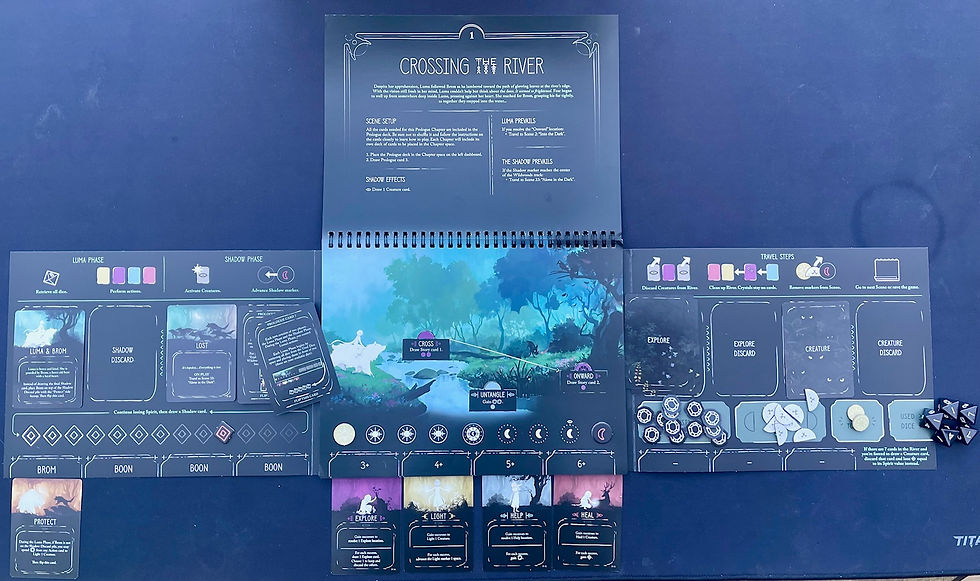
It will walk you through an introduction to the characters and setting. Then have you place your character cards on the space for them on the left of the main board, then the action cards on the river spaces at the bottom of the main board. The story deck will be placed on the left side, with the shadow card placed into its own space face up, then the two Explore cards that you get int he prologue are put into the explore slots. All these cards come from the top of the action deck and are in order, so are right there when you need them and the cards tell you to take them. It is all very intuitive. You move them as and when the prologue cards tell you to. Next, take the creature cards out and place them once shuffled face down onto their space on the right. Now place out the crystals, location markers, dice, and stun tokens into their space on the right. Now place the spirit marker and wildwoods markers out in the spaces as directed by the prologue cards. You are now ready to start your game in earnest.
How To Play Storyfold: Wildwood
You will now be looking at the Crossing the River story on the main page. This tells you that you will win if you can meet the scene's required conditions, which is moving the light marker to the centre space and resolving all "Onwards" locations on the main board.
On your turn, you will run through two phases. The Luna phase where you take your actions and then the Shadow phase where the game fights back! As you play through these phases in the Crossing the River chapter, you will be taught the final mechanics and rules of the game as you play.
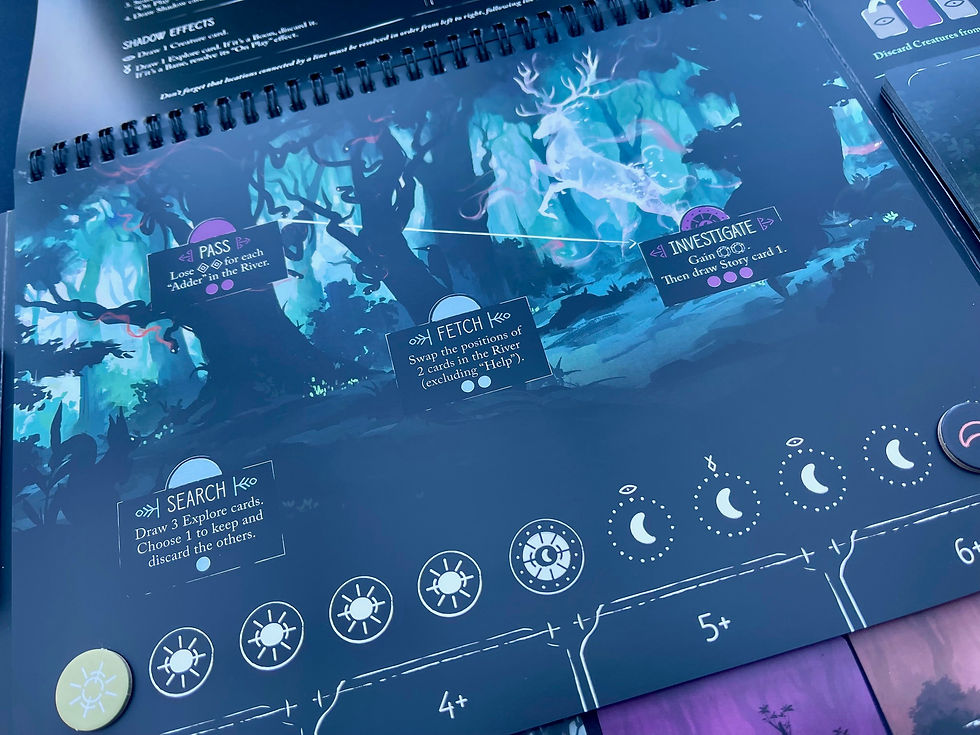
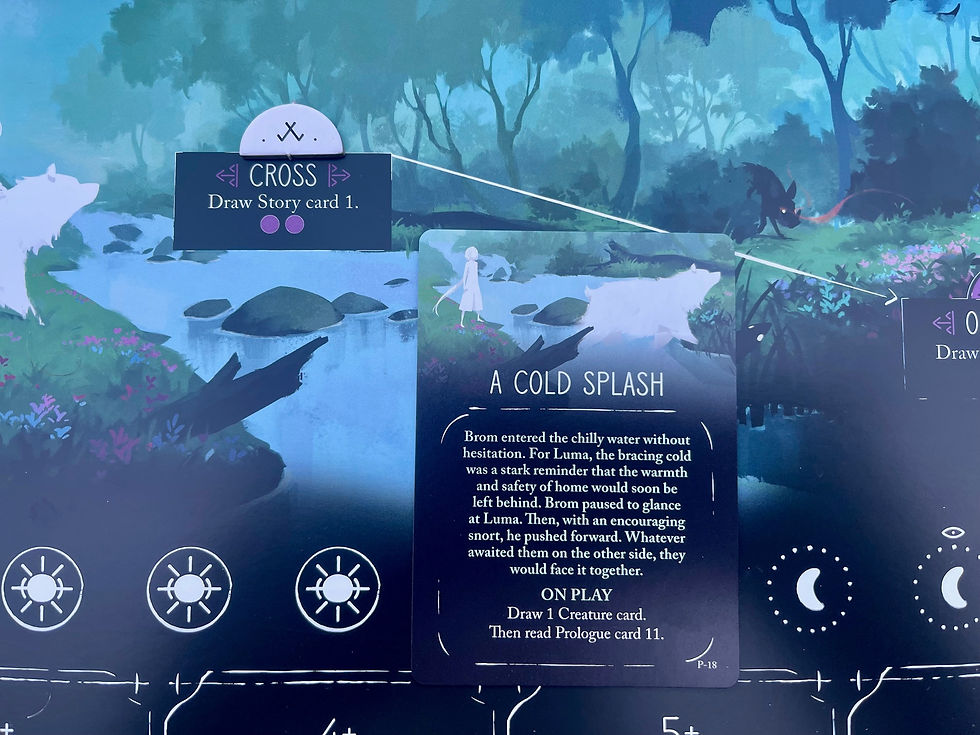
During the Luna phase, you will take all the available dice and then decide how you want to use them. There are four actions available at the start, and these are the action cards you placed into the river during setup. These are Explore, Light, Help, and Heal. When you look at the main board, there will be a set piece Scene visually displayed. On the Scene, there are various prompts related to things you see there, that indicate things you can do in this Scene, Cross, Untangle, and Onward. The prompts have colours on them that match the Action cards, so you can see which actions can be done where. For example, in this first learning game, you can use the Purple on the Cross or Onward prompt actions, and the Explore action is Purple. So, to attempt these actions, you must use the Explore card. Cross means to cross the river in the picture. Onward means to move onto the next scene. Remember, you must resolve all Onward locations to complete this Scene.

There is an arrow connecting the Cross prompt to the Onward one. This means that you must complete the Cross action first. There are also two purple circles under this action, meaning that you need two successes to complete this. The Explore card was initially placed in the river under the 3+ space, meaning to get one success you need to roll a three or higher. Each space in the river has a different success rate targets, going up one by one as it moves to the right, up to a maximum of 6+. Don't worry, the dice you roll are D8s. And it's up to you how many you want to roll to get the successes you need each time. But if you fail, those dice are all wasted, so you will want to hedge your bets! And when all your dice are used, that's your Luna (action) phase complete. And as this is a timed game, in that you have a limited number of turns before the game will eventually beat you, (not timed as in it's on the clock!) you need to be mindful about every decision, and every roll.
So, see your dice as your resources to carry out actions. Treat them well. Look after them. When you roll your chosen amount, if you get the required number of successes, you can take a location marker from the right side of the board and place it under the action you just completed on the main board to mark it as complete. However, in this prologue, the instructions tell you how many dice to use, and that you have free re-rolls while you get used to the game. That will not be the case after this first chapter. Don't get used to it. The purple actions are all about advancing the story. Many of the locations on the scene you complete will show an action to take, such as drawing more cards or gaining more tokens. Cards may have other effects, like drawing Creatures cards or other events. Everything here connects and advances the story. When you draw a Creature card you must add it to the River, the cards at the bottom of the deck.
Many Creatures have an on-play effect that comes into affect as soon as you bring them into the game. The Creature will be placed at the end of the river, the far right space, or where its card text shows. As you use action cards, they move to the end of the river, and as such, everything else shuffles down one place to the left. So now, after your Explore action, you will move your Explore action card that you just used to the far right, meaning the Creature card you just placed as a result of all this, will move one space to the left just behind this Explore card. This of course means that action cards will have a different success rate based on where they are in the river when you choose to use them; and Creatures move towards you after every action that you take! This is bad, as we will learn shortly.

The other three main actions allow you to Light, Help, or Heal. Here in this opening scene, you have one other Purple Explore action and one other Blue Help action. They all work the same, and it is simply a choice of what Actions you want to do, and the order you do things. You will make these choice based on the position of the Action card in the river, the required successes needed, and what you think is your current priority.
All cards have a top and bottom effect. You can use the bottom effect if you fail the roll but get at least one success. The top action of Light also lets you stun Creatures in your River, meaning they don't activate that round. A temporary respite from their attack. Each Creature will show a number of red and yellow circles on the bottom of the card. The number of yellow circles represents the number of successes you need to stun them from a Light action. Place a Stun token on the Creature you stunned to remind you, and move them to the end of the river to also slow their progress. Or you could use the Heal card to remove the card from the River entirely. Check the number of red symbols on the bottom of the card, much like in stun, and this shows the number of successes needed to heal them. If you are successful, the Heal action means you can remove them from the River, moving them to the Creature discard pile. On the bottom right of the Creature card, you will see symbols showing your reward, which would often be Crystals.
The bottom affect of Light is how you advance the Light marker, one of this scenario's win conditions. Help's bottom affect gains you a Crystal, which can be treated as successes on later rolls. When you do this, take a crystal from the supply and add it to one of the four Action cards. Then, the next time you take one of these actions, you can use these crystals as a guaranteed additional success, so long as you get at least one success from your dice. The Heal action lets you move the Light marker in your favour.

When you run out of dice, you then move to the Shadow phase. Here, any Creatures in the river are activated, in turn order, starting with the ones closest to the left space. Each Creature will have a symbol on the top right showing how much Spirit you lose at this phase. Some also have an Activate prompt on the card and generally do bad things. Hence, you not wanting them in your river. When you move the spirit track, move it back one space on the track on left side of the board. When this reaches the end, it simply refreshes back to the start, but you must then draw a Shadow card, and these are always bad! If ever you cannot draw a Shadow card when you have to as you have run out, this is another way to lose the chapter. However, the Brom card you placed during set up can help here by giving you essential one get out of jail free card, and you gain one more turn. But if you have used that up, its game over.
After all Creatures have activated, you then move the Shadow marker on the right side of the middle board one space to the left. If this ever makes it to the middle, then you lose the scenario. Remember, this is a timed game. When you move the Shadow token, look out for symbols above it in its new space; many of the locations require you to activate different things as you move into them, such as drawing extra Creature cards. You can see how things can really escalate in this game! You will then move back into the next Luna phase with all your dice refreshed. You keep playing until you either meet that scenarios win or lose conditions. If you win, you can move on to the next round. If you lose, you can try again.
The game plays over various scenes and chapters, with a continuing narrative running throughout. There are various places where you may die and have to reset and start that chapter again. You can save your progress at any point, but it is easiest at the end of each chapter. Or you can play through continuously. Each chapter takes about 45 minutes to an hour, depending on your play style and luck with the dice.
As you continue through the game, you will gain new powers (cards and dice), build up your deck of Explore cards to be either better or worse, depending on your performance in previous scenes, and uncover the story that unfolds in the game. There are five chapters in total, with multiple scenes in each chapter, and more than one path to take as you play, based on your decisions and performance. And there is more than one ending, plus some ways to adjust the difficulty once you have finished the game and want to try again. Plenty to enjoy!
Is It Fun? Storyfold: Wildwoods Board Game Review
What is good About Storyfold: Wildwoods?
Storyfold: Wildwoods delivers a relaxing solo experience that feels fresh, warm, and inviting. The game drops you straight into its world with no rulebook and lets the prologue teach you as you play. This creates a smooth opening chapter that feels natural, almost automatic, as you discover how the system works. The art and production carry a huge amount of charm. Everything feels designed to help you settle in, breathe out, and enjoy the journey.
Another highlight is how well the game blends narrative with mechanisms. The river system is simple but clever, creating a constant flow of tension as creatures drift closer while your action cards shift in value. The story moments connect cleanly to what happens on the board, and small rewards like crystals, new cards, or even new dice make progression feel meaningful. It gives you that pleasant sense of moving through an unfolding tale while still making small, satisfying choices along the way. You feel in control, if somewhat lacking complete agency due to the dice rolls.

What is not good About Storyfold: Wildwoods
The gameplay can feel repetitive once you understand the rhythm. You are rolling dice, managing the river, and reacting to creatures in a loop that does not always evolve as quickly as the story suggests. Some players may also find the luck from the dice rolls too influential on the overall experience. You have some mitigation with the crystals and the order in which you take your actions, but mostly, your choices will feel pre-scripted and a little railroaded, and if you roll well, then great! But if not, things can be demoralising. And Wildwoods uses dice heavily. A critical fail at the wrong time can undo careful planning or force you into a reset that feels more annoying than dramatic. I am not a fan of having to re-do levels because I failed, especially if nothing really changes on the second attempt.
Who will like Storyfold: Wildwoods and who will not
If you enjoy narrative driven solo adventures with gentle pressure, you will love what Wildwoods offers. It rewards players who like atmospheric games, intuitive systems, and the feeling of playing through a storybook. However, players who want strategic crunch or deep mechanical variety may not connect with it. Wildwoods is built to be soothing, not sharp. If you are looking for big twists or tough tactical demands, this will not be the right fit.
Pros
Stunning art and production
Smooth onboarding with prologue tutorial
Relaxing and atmospheric solo experience
Clear card based system that teaches itself
Nice sense of progression across chapters
Multiple endings and replay value
Cons
Early chapters feel slow and guided
Dice driven outcomes can feel repetitive
Limited strategic depth
River movement can become predictable
Not ideal for players wanting strong mechanical challenge
Storyfold: Wildwoods is a gentle solo adventure that leans into mood, immersion, and a relaxing pace. It shines when you embrace the narrative and enjoy the cosy atmosphere. It stumbles a little when you look for deeper strategy or fast escalation. For players who want a calm and story heavy experience with beautiful production and a clever onboarding system, this will feel like a welcome escape. For players who want crunch, tension, or variety, it may feel too light.
Overall, it is a charming and thoughtful solo journey that knows exactly what it wants to be. It's up to you if you want to be a part of this world or not. I certainly enjoyed my time with it and found the sense of discovery, both for the story and advancing mechanics with new cards and dice, exciting to discover the first time. I may not come back to it for a while, but I logged plenty of games with this first run through, so I certainly feel you would get your money's worth.


