

Scales of Fate Board Game Review

WBG Score: 8
Player Count: 2
You’ll like this if you like: Veiled Fate and two player deduction games
Published by: IV Studio
Designed by: Max Anderson, Zac Dixon, Austin Harrison
This is a free review copy. See our review policy here
Some two-player games feel like smaller versions of something built for more people. Scales of Fate does not. It feels completely designed around the tension of sitting opposite one person, watching every move they make, trying to work out what they are really doing while giving away as little as possible yourself.
It is short too. A full game can come in at around 25 minutes, setup is easy, the rules are surprisingly straightforward, and there is almost no downtime. More importantly, you never really switch off when it is not your turn, because every move your opponent makes might be helping them, hurting you, disguising something, or doing all three at once.

How to Play
At the start of the game, all nine demigods begin on seven Renown, and each player secretly receives two demigod cards from their own identical deck. That last point is important because both players can potentially care about the same demigod, which immediately makes the deduction less obvious than simply working out which pieces your opponent keeps helping. The aim of the game is to get your two demigods to be either as far away from each other as possible on the scoring track, as you score the difference between the two, or on the same spot, where you score the spot they are on.
The game lasts three Ages. On your turn you normally place a demigod onto an action tile, but you could also place a previously gained Servant or use one of the three God Powers, or pass when you no longer have normal actions available. The action tiles let you Smite a demigod into the Abyss, influence what happens to those in the Abyss at the end of the Age, or gain Servants that can later manipulate Renown.
Servants are the main way you actually move demigods up and down the Renown track. Different servants interact with different quest types and can sometimes hit several demigods at once, which creates some very satisfying tactical swings. Placing them will move the affected demigods up or down the score track, based on what tiles they are next to, and where you place your servants. So when you place demigods onto the board, and where you place servants will all give clues to your opponent about your intentions. There is enough going on to make each move matter, but never so much that the game becomes difficult to follow.

The Real Game Is Reading the Other Player
This is where Scales of Fate really works for me. You are not just trying to improve your own position. You are also constantly interpreting your opponent’s actions while trying to make sure they cannot interpret yours.
Did they move that demigod because it belongs to them? Did they move it because they think it belongs to you? Are they helping one of their own while pretending not to care, or are they simply setting up a bigger tactical move somewhere else? Because both players can potentially have the same hidden demigod, even an apparently obvious clue can be misleading.
That creates a lovely little game of bluff and counter-bluff. Sometimes the smartest move is not the one that scores the most immediately, but the one that muddies the water enough to keep your intentions hidden. And sometimes you realise your opponent has spent the whole game feeding you exactly the wrong story. In joyous!

Two Very Different Ways to Score
The scoring system is one of the smartest parts of the design. If your two demigods finish on different Renown spaces, you score the difference between them. If they finish on the same space, you score the value of that space instead.
That gives you two very different paths. The safer route is often to push one demigod high and one low, creating as much distance as possible. The more daring route is to try to get both onto the same high-value space, which can score very well but is far more vulnerable to interference.
I have managed that second strategy a few times, and it is wonderfully satisfying when it comes off. It definitely helps if you have the final move of the third Age, though, and it becomes much harder if your opponent has already identified both of your demigods. If they know what you are trying to do, they can destroy that perfect alignment with one well-timed move.

Deduction That Actually Matters
At the end of each Age, both players answer a yes-or-no question based on the current Age card. Those questions give partial clues about your hidden demigods without necessarily giving away exact identities, which keeps the deduction developing gradually rather than turning into a single obvious reveal.
Then, at the end of the game, both players make their final guesses. Correctly identifying both of your opponent’s demigods is worth three points, identifying one scores nothing, and missing both costs you one. That sounds small, but in a tight game those points can absolutely matter.
More importantly, the reveal is just fun. Guess correctly and there is a proper little moment of satisfaction as all those tiny clues click into place. Guess wrong and, rather than feeling cheated, you often end up appreciating just how well your opponent disguised what they were doing.

Powerful Tools, Real Costs
The God Powers add another nice layer. Smite can throw any demigod into the Abyss, Switch lets you swap any two demigods anywhere, and Steal takes an unused Servant from your opponent.
They are powerful, but they are not free. Each costs you a whole turn and one victory point at the end of the game, and once used, that power is gone for good. That makes using one feel significant rather than automatic, which fits the rest of the design perfectly.
Everything in Scales of Fate feels like that. There is no obvious filler, no action that exists simply because the designer wanted one more mechanism in the box. The systems are compact, interconnected and nearly always force you to think about both the visible board state and the hidden intentions behind it.

Production
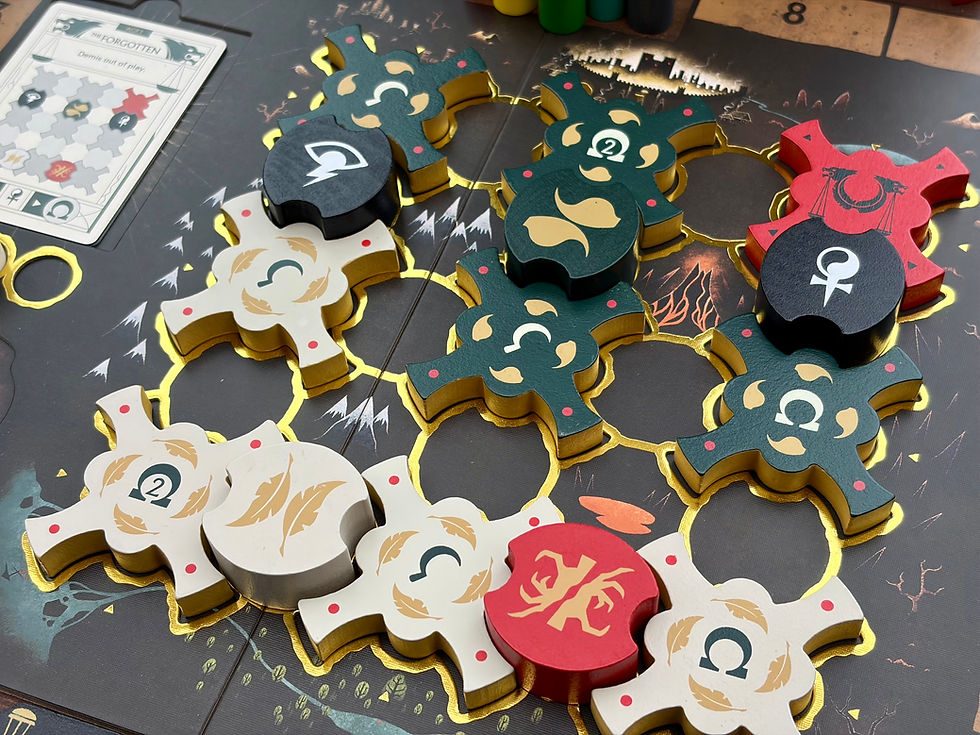
The production is excellent. The chunky, weighty pieces feel great in the hand and give the game far more physical presence than you might expect from something this short. It also looks superb on the table, with the board’s interlocking shapes and layered spaces giving the whole thing a distinctive identity.
The theme itself is much less important. Mechanically, this is really an abstract tactical duel with a demigod skin, and I never felt particularly invested in the world or characters. That does not bother me much because the underlying game is strong enough, but anyone coming in because they want a rich mythological experience may find the setting thinner than the presentation suggests.
The iconography can also take a little getting used to. Several of the demigods and visual identifiers are close enough that you may need to pay more attention than feels ideal in a game built around information management. It is not a deal-breaker, but it is probably the weakest part of an otherwise very polished package.
Pros
Excellent two-player-only design with almost no downtime.
Clever mix of deduction, bluffing and tactical board manipulation.
Brilliant scoring tension between separation and matching Renown.
Superb chunky components and strong table presence.
Cons
Theme is much lighter than the presentation suggests.
Some iconography and demigod identification could be clearer.
Deduction may feel a little fuzzy if you prefer hard logical certainty.
Very much a dedicated two-player experience, so naturally niche.

Final Thoughts
Scales of Fate is exactly what I want from a dedicated two-player game. It is short, easy to teach, fast to set up and packed with meaningful decisions from the first turn to the last. There is no long wait between actions, no period where you feel out of the game, and no real downtime because your opponent’s moves are just as interesting to watch as your own.
The thing I like most is how well the different layers interact. You are manipulating Renown, protecting your own scoring plan, trying to read your opponent, disguising your priorities and working out whether to chase a safer spread or a riskier matched score. None of those things sit separately, and that is why such a short game can still feel so full.
Then you get the final guesses, which give the whole experience a satisfying little flourish. Sometimes you feel like a genius. Sometimes your opponent reveals just how completely they fooled you. Either way, for around 25 minutes of play, Scales of Fate delivers a wonderfully tight and engaging duel.


