

Realm Of Reckoning Board Game Review

WBG Score: 8/10
Player Count: 2-5
You’ll like this if you like: Rising Sun, SETI, and dark boards!
Published by: IV Games
Designed by: Austin Harrison, Max Anderson, Zac Dixon
This is a free review copy. See our review policy here.
Realm of Reckoning is a game that looks complicated, sounds complicated, and initially feels complicated. Then, somewhere during your first game, the noise begins to settle and you realise the core is surprisingly clean. You draft a card, gain something useful, tuck it into your player board, and prepare for the next reckoning.
That simplicity sits beneath one of the more interesting scoring systems I have encountered recently. Players do not begin the game knowing exactly what will score, because those conditions are introduced gradually through the placement of monuments. You are not merely reacting to the rules of the game, you are actively helping to decide them.
This is a game for two to five players, although three or four feels like the natural sweet spot. But I did enjoy the two-player variant. It plays across three ages, with only a small number of cards drafted during each one, so the whole experience moves much faster than the board and component count might suggest. My games have flown by, even when everyone has spent time agonizing over the reckonings. Which can happen. More on that soon!

How To Setup Realm Of Reckoning
Setup begins with the large central board, divided into five regions linked to the five pillars of the realm. Claim tokens are placed around these regions, monuments are arranged beside the board, and the various decks are prepared according to the player count. There is a fair amount to place, but the storage makes this easier than it first appears.
Each player chooses one of the five factions and receives a player board, scoring markers, acolytes, a bidding dial and their starting resources. The factions begin with slightly different combinations of influence, wardens and acolytes, although the asymmetry is fairly light. And you just copy the images on your board so its all very simple. These differences provide a useful opening direction without locking anyone into a specific strategy.
The action decks are then prepared for each of the three ages, with reckoning cards shuffled into them. A public final reckoning is also revealed, giving players some advance warning of one region that will definitely matter. Place the two-player tokens into the bag if you have two players only and set up the cards as in a three player game. Once the first hands are dealt, the game is ready to begin, although new players may still be studying the board and wondering where half the scoring spaces are!

How To Play Realm Of Reckoning
During each round, every player chooses one card from their hand and reveals it simultaneously. Cards are either action cards or reckoning cards. Once all cards are actioned, players pass their cards to the next player and choose one new card from their new hand. Action cards provide a central reward such as coins, acolytes, wardens, or mercenary cards, after which the card is tucked beneath the top or bottom of the player board. Each card gives you two options. The chosen side determines which influence track advances and which scoring symbols are collected.
For example, below you can see the first card will let you add three acolytes to the board, anywhere you like, but ideally to places where there will be reckonings this era. And then you can tuck it either on the blue or red part of your player board, gaining the symbols shown. I won't go into the details of that here, but it's all about end-of-era scoring. Moving up different scoring tracks, and also scoring multipliers. Such as the blue scoring which could be about open eyes as seen on this first card, or closed eyes, as seen on the card on the right below. Only one of these will score. It could be neither, but cannot ever be both!

Influence can also grant access to powerful artifacts, which provide ongoing bonuses while you remain ahead on the corresponding track. These can improve actions by granting extra coins, cards, acolytes, or influence, and they are often worth fighting over. This is done by moving up each of the area's tracks with these icons, and when you reach space three or higher, you can gain that area's artifact and begin to use it. But if another player catches you up or overtakes you, or you fall below two, then you will lose it.

Reckoning cards pause the normal draft and trigger a hidden auction in a particular region. Players secretly bid using influence, acolytes, wardens, mercenary cards and coins, with the highest bidder choosing first from the available rewards. Players assess who bid the highest, and then they can chose their chosen reward in bid order.

The most significant reward allows a monument to be placed, permanently introducing a new scoring condition that will trigger at the end of the current and future ages. Secondary rewards include coins, points, and places acolytes onto the board. The third place spot will often lose money, cards, or points.

Play continues for three rounds. With a reckoning at the end of each round, and then each point-scoring monument placed thus far is scored. Therefore, a monument placed in the first round will score three times, whereas ones scored in the final era only score once.
Game Experience of Realm Of Reckoning
The player-defined scoring is comfortably the best part of Realm of Reckoning. A game may become focused on area control, influence tracks, coins, wardens, mercenary cards, or collecting sets of icons, depending entirely on which monuments are built. The timing matters too, because a monument placed in the first age will score three times, while one placed late may only matter once. But it changes each game; it's up to the players in the game. And it makes winning the bid on the reckoning so important, and every decision feel crucial.
This creates a brilliant sense of ownership over the shape of each game. You can invest heavily in a resource and then attempt to make it score, but everyone can see what you are doing and may block you during the draft or outbid you during a reckoning. Alternatively, another player may introduce a condition that suddenly makes something you ignored painfully important. Or, they could just score the opposite of what you were building!
The reckonings themselves are tense and clever, especially because coming second can still be perfectly acceptable while finishing last may carry a meaningful penalty. In the two-player mode, a neutral bidding token provides extra competition, escalating across the three ages and preventing the auctions from becoming predictable. It is simple, effective, and forces both players to respect every reckoning, even when the other player appears unable or unwilling to compete. Coming second is okay, coming third is bad! But winning is everything! Especially in the early rounds when you can set the agenda. But also, in the later rounds when the final scoring becomes so tight.
That said, reckonings can feel like an interruption to the otherwise fast and enjoyable flow. The card draft moves quickly, turns are short and the game has a satisfying rhythm, only for everything to stop while players calculate their maximum bids and consider the rewards when the reckonings come. They are essential to the design and create its best moments, but the transition into them can still feel slightly awkward, and sometimes annoying.

The production is excellent, even in the standard retail edition. The wooden components are chunky, attractive, and satisfying to handle, the player boards work beautifully, and almost everything arrives ready to play without sheets of cardboard to punch. The player boards are dual-layered underneath, so you can slide the cards into each spot in a very simple and satisfying way. That said, that's the first card. When it comes to adding the second, third, and beyond, it does start to get a little less simple and clean. As you can see above, they start to look less clean and tidy. And putting extra cards in is frankly annoying. You do need to see the icons, especially on the reds, and they slip about a but. It's not a big problem, just the effort into making the first card slide in perfectly versus how it feels for multiple cards does jar for me.

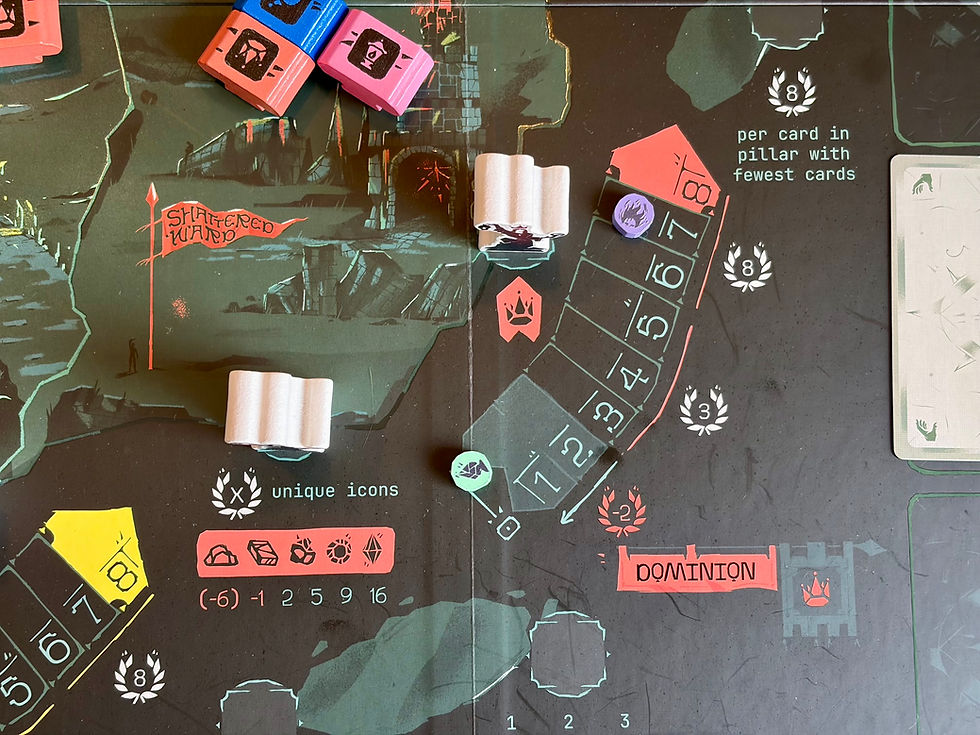
Another exception to the otherwise wonderful production is the central board, which is dark, busy, and initially difficult to read, and it took me around three games to properly notice every monument space and scoring area. At first glance, it was just a mess of "things." It is now clear to me, but for players' first games, you do need to spend some time explaining the scoring options as well as the game, as that is such a huge variation and sets your strategy from turn one. Missing this from the teach can ruin a player's game if they don't understand the available options. And the dark, cluttered board does not help this at all. The places you can add a scoring monument are the square-shaped blank spaces with the brackets on the top and bottom. Just look below at how many there are, how scattered they are, and the amount of text around some of them explaining how they work.

Pros
Dynamic player-controlled scoring makes every game feel genuinely different.
Reckonings create tension, interaction and meaningful resource decisions.
Fast turns and only three ages keep the game moving quickly.
Excellent components, storage and standard retail production.
The two-player bidding system is clever, simple and surprisingly effective.
Cons
The central board is dark and initially confusing to read.
Scoring locations and monument options take several games to fully absorb.
Reckonings can interrupt the smooth rhythm of the card draft.
Bidding can encourage calculation and analysis paralysis.
Some scoring conditions may feel easier to exploit than others.

Final Thoughts On Realm Of Reckoning
Realm of Reckoning is a clever, interactive strategy game built around a genuinely strong central idea. Allowing players to decide which systems will score gives every action more weight and ensures that no two games develop in quite the same way. It rewards planning, but it also rewards flexibility, awareness and the ability to react when another player changes the rules beneath you.
The game looks heavier than it plays, although it takes time to become fully comfortable with the board and its many scoring possibilities. Once that visual confusion fades, the underlying structure is fast, accessible and satisfying. The reckonings occasionally break the flow, but they also provide the drama and difficult decisions that make the game memorable.

Three or four players is probably the ideal count, offering enough competition without stretching the playtime too far. However, the two-player mode works far better than I expected and still creates meaningful tension around every auction. Realm of Reckoning is not flawless, but it is inventive, beautiful and highly replayable.


