

Origin Story: Heroes & Villains Card Game Expansion Review

WBG Score: 8.5
Player Count: 1-5
You’ll like this if you like: Origin Story, trick-taking games, greater variety, and expansions that improve a game without complicating it.
Published by: Stonemaier Games
Designed by: Jamey Stegmaier, Pete Wissinger
This is a free review copy. See our review policy here.
Origin Story was already one of the more interesting modern trick-taking games. It combined familiar card play with tableau-building, stamina-powered abilities and a surprisingly effective superhero theme, letting you gradually construct the character you would become. You can read my review for the base game here. Heroes & Villains does not attempt to redesign any of that. Instead, it takes one small part of the game, adds considerably more variety, and makes the final chapter of your story feel a little more appropriate.
This is a mini-expansion in every sense. It adds just 21 cards, introduces no major new rules and costs only £6/$7. However, those cards target the area of Origin Story that was always most likely to become familiar after repeated plays: the final superhero reveal.

What Does Heroes & Villains Add?
In the original game, each player received two superhero cards at the beginning of the game. These remained hidden as reference cards until the final round, when you chose one, revealed your completed identity and gained its ability. There were only ten superheroes in the base game, meaning regular players would inevitably start seeing the same identities again.
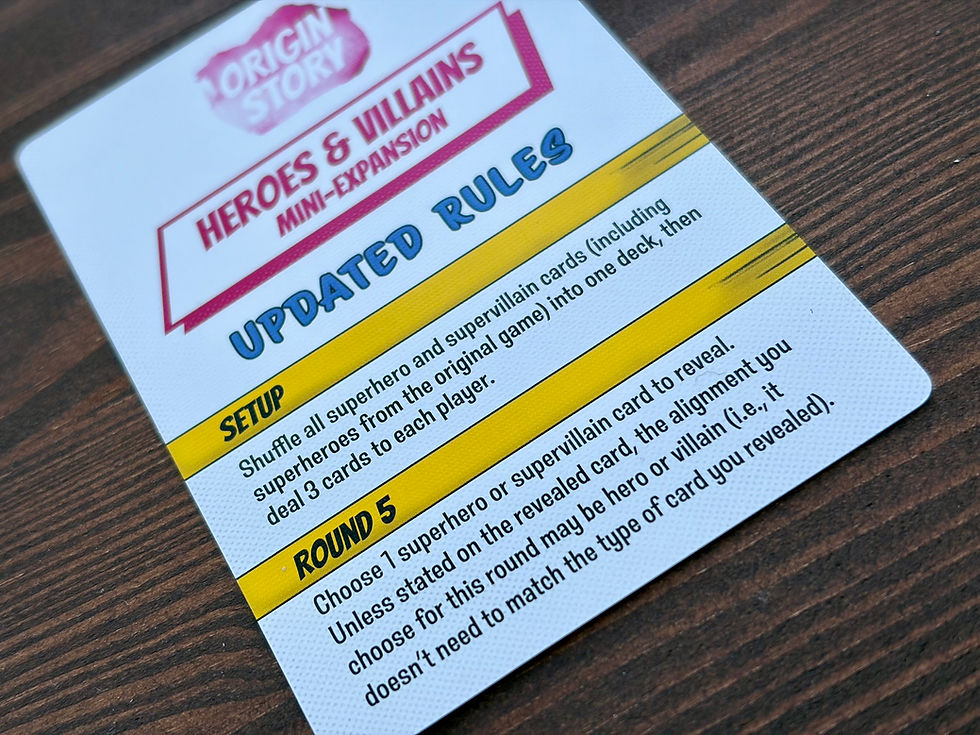
Heroes & Villains adds seven new superheroes and 14 supervillains, increasing the identity deck from ten cards to 31. All of the old and new cards are shuffled together, and players are now dealt three possible identities rather than two. You still make your final choice at the beginning of round five, once your Story tableau is complete and you have seen your final hand.
That is essentially the entire rules explanation. There is no separate villain deck, no additional phase and no complicated system to remember. Shuffle the cards in, deal everyone one extra option and play Origin Story as normal.

A More Suitable Ending
The addition of supervillains makes immediate thematic sense. Throughout Origin Story, players secretly decide whether they will act heroically by attempting to win tricks or villainously by trying to avoid every trick in the round. Despite this, the base game always concluded with everyone becoming a superhero, even if their journey had been filled with underhanded choices and villainous behaviour.
Heroes & Villains allows those darker stories to reach a more fitting conclusion. You are not forced to become a supervillain simply because you previously chose the villain alignment, but having that possibility makes the identity system feel more complete. It closes a small thematic gap without changing how the game itself works.
This is not a huge storytelling transformation, and the expansion never pretends that it is. You are still primarily playing a strategic trick-taking game rather than acting out an elaborate comic-book narrative. However, revealing a villain after spending several rounds manipulating tricks, avoiding victories and frustrating the heroes around the table simply feels right.

More Choices, More Variety
The most meaningful improvement is the increased variety. Moving from ten identities to 31 is a substantial increase, especially when each player sees only three during a game. It will take far longer before the final cards begin to feel repetitive, and multiplayer games no longer burn through such a large percentage of the available identities every time you play. Receiving three cards instead of two also gives you more flexibility. You can examine your possible final identities from the beginning, consider how they might interact with the Story cards you acquire, and gradually build towards whichever option appears most useful. You are still dependent on the cards you are dealt and the Story choices you are offered, but that uncertainty has always been part of Origin Story.
The new abilities explore different corners of the game without becoming more complicated than the original cards. Some reward particular Story types, some interact with discarded cards, while others encourage unusual changes in alignment or approach. They do not create an entirely new strategic layer, but they give established players more combinations to discover and more reasons to adapt their plans.
There will inevitably be situations where one identity appears much stronger than another. Origin Story contains random hands, random Story cards and circumstantial powers, so perfect balance was never a realistic goal. The important point is that you can see your three possibilities from the beginning and delay your final decision until you understand how your tableau and last hand have developed.

Small Change, Fair Price
It would be easy to criticise Heroes & Villains for being slight, but that would ignore both its price and its purpose. This is a £6 mini-expansion, not a large boxed release promising new modes, mechanisms or hours of additional content. It identifies a part of the game that could use more variety and expands it in the simplest possible way.
You may wonder whether some of these identities should have been included in the original box. More final identities would certainly have improved the base game’s long-term variety, and the option to become a villain feels so natural that its absence now seems more noticeable. Even so, the original game remained a complete and highly enjoyable experience without them.
The expansion also avoids a common problem with additional content. It does not make Origin Story slower, harder to teach or more difficult to store. The new cards can simply remain shuffled into the identity deck for every future game, and there is little reason to remove them once added.
Is It Fun?
Heroes & Villains makes Origin Story better, but it does so quietly. It will not completely change how you feel about the base game, and anyone who disliked its mixture of trick-taking and variable powers will not suddenly be converted. What it does is make the final round fresher, broaden the available strategies and give villainous journeys a more satisfying destination.
The larger identity deck also restores some mystery to the final reveal. You are less likely to recognise every possible ability or anticipate exactly what another player might become. That uncertainty suits a game built around evolving powers, hidden alignments and sudden changes to established trick-taking rules.
Most importantly, the expansion provides good value. For £6, it adds cards that will be used in every game, significantly increases one of the base game’s smallest decks and requires almost no additional explanation. It is difficult to ask much more from a mini-expansion.
Pros
Significantly increases the variety of final identities
Supervillains provide a more fitting conclusion to darker stories
Integrates seamlessly without adding complexity
Excellent value at only £6/$7
Cons
The change is small and will not transform the base game
Some players may feel this content should have been included originally

Final Thoughts
Origin Story: Heroes & Villains is a modest expansion that knows exactly what it wants to achieve. It does not introduce a dramatic new mechanism or attempt to rebuild a game that was already working well. Instead, it adds variety, improves the thematic logic of the final reveal and gives players more interesting possibilities to consider throughout the game.
For anyone who already owns and enjoys Origin Story, this is an extremely easy recommendation. The impact is subtle, but the price is equally small, and the new cards can remain permanently mixed into the game without adding rules or slowing anything down.
Heroes & Villains may not rewrite Origin Story, but it gives far more stories the ending they deserve.
