

Euphoria: Build a Better Dystopia Board Game Review

WBG Score: 8.5
Player Count: 2-6
You’ll like this if you like: Fast playing worker placement games
Published by: Stonemaier Games
Designed by: Jamey Stegmaier, Alan Stone
This is a review copy. See our review policy here
Back in 2013, Stonemaier Games had released Viticulture. and that's it! The world was yet to be blessed with games such as Scythe, Wingspan, and Tapestry. Huge pillars of the board game community. But Viticulture had come out, was a huge success, and the newly formed indie publisher Stonemaier games, quickly hit back with a second release of the year, Euphoria: Build a Better Dystopia. The game received positive reviews, but some reason, never became as big a hit for the publisher as what had come before, and what was to come. Perhaps the theme wasn't for some? Maybe people felt this was too complicated. It does have a busy board. The Kickstarter deluxe version had a greyscale reverse side to the board which designer Jamey himself encourage people to use for early games. I'm not sure myself if this was necessary, or why the game didn't quite hit the heights of Viticulture, but let's get it to the table now and see if it still delivers.

How To Set Up Euphoria: Build a Better Dystopia
First, lay out the game board. You will need a bit of space either side for the players. Now, place onto the board the resources for the four different factions. Up top, you will place the Bliss (cloud shaped green things!) with the Icarites in the sky. On the right, with the Wastelanders, place the green Food tokens; then by their tunnel that they are digging to the Euphorian's, place the Clay. Doing tings like this, helps you learn the board. Hence, me explaining it this wat. Its a good way to teach the game. Do the same with the Energy by the Euphorian's, and the Gold by their tunnel, and the Water and Stone by the Subterrans at the bottom of the board. You will notice star-shaped locations in the four factions' areas. Block off spaces in these until you have spaces remaining that match your player count. One available space for each player in the game, no more.
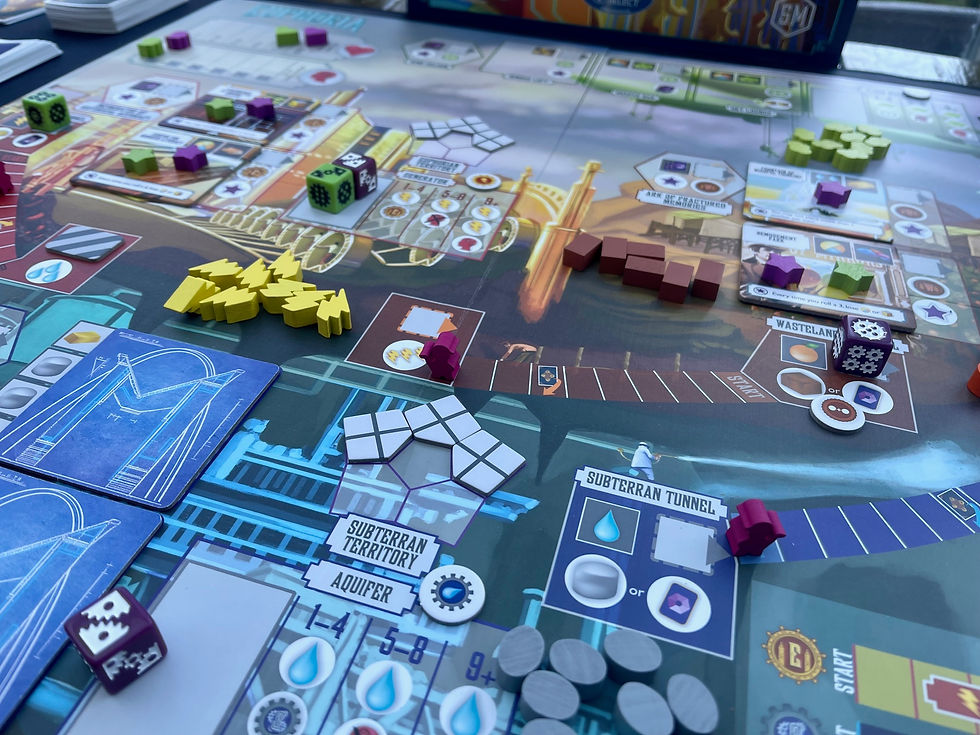
Next to the board, place the two decks of cards, shuffled, and deal out four recruit cards to each player. They will look at them, keep two, and discard the rest. Give each player a resource multiplier card and two dice in their colour. Each player roles their two dice and places them in front of them, the highest role is the starting player. Place the other two dice of each player's colour by the board; they may be able to recruit them as extra workers later. Then give each player their ten Authority tokens in their colour, which they place by their side, and the heart-shaped Morale token and heart-shaped Knowledge token. These are placed into the first and third spaces respectively in the trackers for them on the top left of the board. Then place unavailable action tokens onto the spaces at the end of the three tunnels. They are available when you tunnel through the tunnels in the game. Place Miner meeples at the start of each of these three tunnels, and then add the four Progress tokens on the starting spaces on the bottom right allegiance track. Now, give each player an Ethical Dilemma card; it has a player aid on the back. Place it with the player aid face up. The board should look like this.

Finally, take the Construction tiles, shuffle them up, and choose six at random. Place them face down onto their spaces on the board. Each of the land-based factions has spaces for two each. The Icarites have their own version of this printed on the board already. You are now ready to play, and hopefully understand the board a little bit.

How To Play Euphoria: Build a Better Dystopia
The best way to learn this game is to understand the board. Get to know the main areas of the four factions, three tunnels, and the trackers on the top left and bottom right. When teaching this game, I like to show a few sample turns. On your turn, you can do one of three things: place a worker (dice), remove one or all workers, or activate your Ethical Dilemma card. The Ethical Dilemma card is a one-time action, so most of the game you will be placing or removing dice.
Placing Dice
When you place your dice, you can do so in one of three types of spots. The first of which is one of the three large resource locations that generate Food at the Wastelanders, Energy at the Euphorians, or Water at the Subterrans. You can place as many workers as you like there and there is no cost. Other players cannot block you in this locations, they can hold multiple workers. You will gain resources based on the value of dice there, the collective Knowledge of all workers present. All things you gain in this game are shown in circles. For example, at the Farm, in Wastelander Territory, you will get one Food token and move the Allegiance trackers one space if the collective Knowledge is one to four. Five to eight and you get a Food and reduce your own Knowledge one space on the tracker on the top left of the board. Over nine, and you get two food, but your Knowledge goes up. A key point to explain to new players is losing Knowledge is good. Gaining it is bad. I will explain why later. All resource generation spaces work with the same ratios, just with different resources. You can see the Generator at the Euphorian Territory below is the same.

The second type of place you can place a worker is a smaller hashed line box, which has a cost in a Square for a potentially higher benefit shown in a circle, and you could get bumped. This means other workers can force you off this spot. Not a bad thing, it means you get your worker back for free. Just roll them, perform a knowledge check (more on that soon), and add them back to your available pool. There are two locations like this on the bottom left of the board that let you pay three resources and then you can gain an extra worker (up to four in total, max).
Each tunnel space has a location like this too. Here, you pay a resource, place your worker, then gain one of two benefits, in this case, a Gold or an Artefact card, and then you can move the tunneller meeple one space forward. When it reaches the sixth spot, anyone with an unrevealed Recruit card of this faction must now reveal it. When it reaches the eighth and final spot, you can remove the blocker token, and you have now opened up a new worker placement spot. It will have a powerful benefit. This represents each faction tunnelling into a neighbouring faction to gain access to the resource that they make. A lovely thematic link.

The third type of place you can place a worker is the spaces by the construction sites. Each one has multiple spaces showing a resource. Remember, what you pay is always in a square. There is no benefit to gain here, just a site to build. You need two workers in a two or three-player game to finish a site, three in a four-player game, and four in a five or six-player game. When the required amount of worker dice are placed here, the dice are bumped, rolled, sent back to their owner, who all perform a knowledge check, and then anyone who had a die here adds one of the authority tokens onto the now flipped construction site.
Anyone who didn't contribute to the making of this site misses out on this valuable opportunity to do this, as this is how you win the game. The first person to place their tenth and final Authority token wins the game. So do not miss out on this. Also, if you do miss out, you will notice a huge penalty on the new site. Something that anyone who didn't help build it now has to suffer for the rest of the game. And they are big! Try not to miss out.
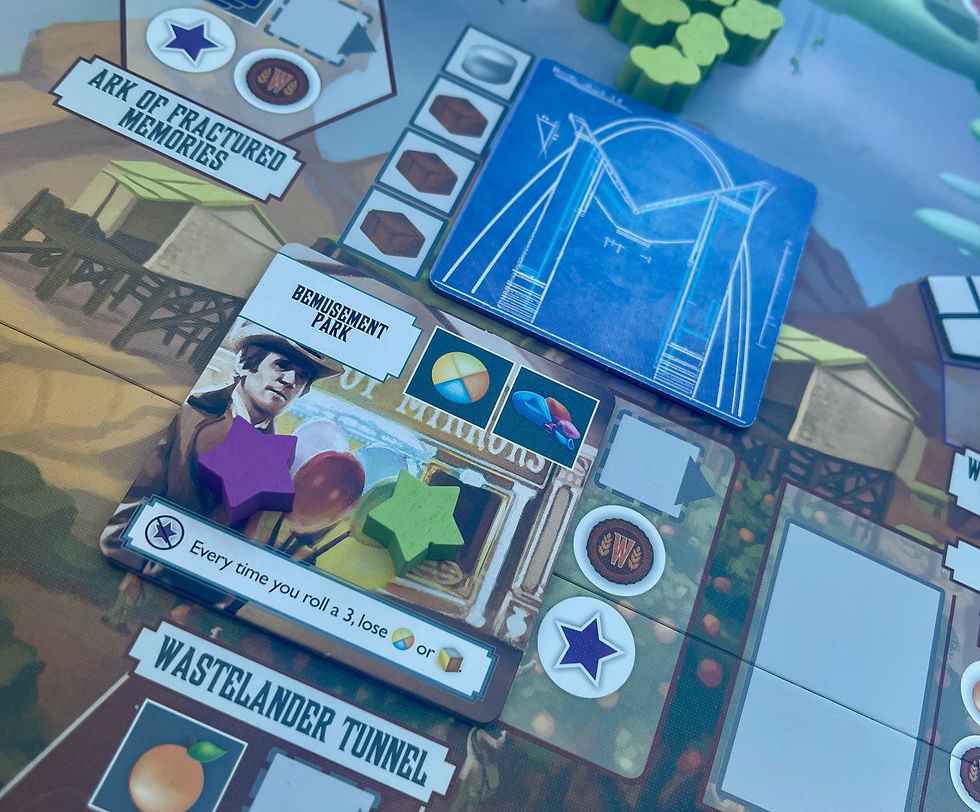
Each site also opens up a powerful new worker placement spot that lets you spend resources and Artefact cards to gain opportunities to place Authority stars into that faction's star-shaped territory. Remember, there are only spaces in these areas for Authority stars to the quantity of players. So, in a three player game, once the third star is placed, that's it. You can still do this action but you cannot place the star anymore! So, again, don't miss out!
Removing Dice
When you remove dice, you have two choices. Pay either a Food or Bliss token and then remove one, some, or all of your dice. Roll them, perform a Knowledge check, and then gain two morale. Or, you can do it for free, and instead of gaining two morale, you will gain one morale.
Morale is important because it is your hand limit. You cannot hold more Artefact cards than your current morale. If you ever gain more, discard down. Artefact cards are important as they are a cost for a few key actions in the game. And you either need to pay two or three cards, or you can reduce the quantity by using matching or specific cards.

Knowledge Check
Whenever you gain a die, or remove one from the board and add it back to your supply, you must perform a knowledge check, as mentioned a few times already. Here, you roll all available dice, so not the ones still on the board if you have any. Then, total up all rolled dice, add your current Knowledge level, and if it matches 16 or above, one of your dice is returned to the unavailable dice on the side of the board. Gaining new dice is costly, so you want to try and avoid this if you can, by keeping your knowledge low, and not rolling more than three dice at once if you can avoid it.
Recruit Cards
During the setup, you can choose two from four cards. During the game, you won't get many more, if any. They are very valuable. They all come from one of the four factions on the board and have a specific challenge on them. When you complete the challenge as shown on the cards, you will flip them over n gain the shown benefit. You will also now gain benefits from them as per the allegiance track. Other actions may force you to flip the cards over too, such as reaching the sixth space on the tunnel for that specific faction.

Allegiance Track
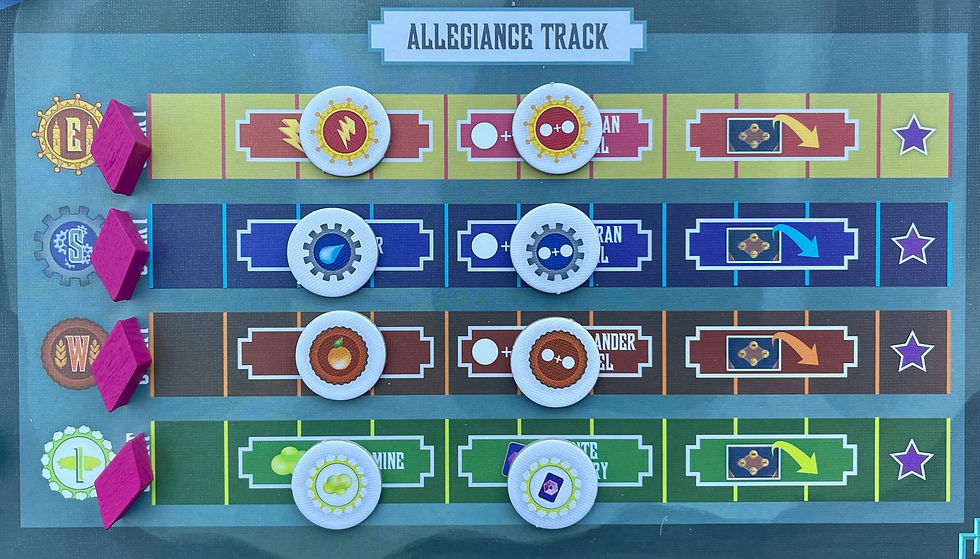
At a few worker placement spaces on the board, you will see one of the four Faction symbols. When you see this, it means you must move the marker on the Allegiance track forward one space. When the marker reaches the second tier, you will move the token there to the resource space for that faction. This will remind you that anytime any player ever takes this resource action again, they will gain an additional resource if they have an active recruit of that type, face up in their play area. In tier two, you will gain both benefits instead of one when you use the tunnel action for that faction. Again, only if you have an active recruit. And in the third tier, anyone with a hidden recruit of that type must now reveal that card. The final space shows that now each player will place one Authority token onto each active recruit from this faction.
Ethical Dilemma Cards
At the start of the game, each player was given an Ethical Dilemma card. At any point in the game, instead of placing or removing dice, you can activate this card as your turn. There are two choices. The right side lets you instantly place one Authority token on it, in exchange for one specific artifact or any two artifacts. Or the left side, which for the same cost, will let you draw two new Recruit cards and then keep one of them. This is the only way you will get extra Recruit cards. So, it's a tempting choice, especially as it may be a way to place another Authority star anyway and also gain the benefits from a developed Faction minor path if you don't have an active recruit already, one that has gone a long way.
Until you activate these cards, they can be used as a handy icon player aid on the reverse.

Double Dice Placement
During the game, if you ever have two active workers ready to be placed and they have the same number, you can place them both sequentially. Meaning, you get more than one turn in a row! This can be very powerful if you get to activate a Construction site and block someone else off, or do this and gain multiple Authority star placement opportunities at once. Catching people out this way can be big as there are a lot of spaces that, when done, are out of the game for other players as we have shown.
So place dice, remove dice, activate your Ethical Dilemma card at the right time, build construction sites, collect resources, dig tunnels, and become the most authoritative leader in the dystopian future! First to place ten stars wins!
Is It Fun? Euphoria: Build a Better Dystopia Board Game Review
Why Euphoria Can Be Great Fun
Euphoria is fun because it delivers a clever mix of worker placement and dice that always feels tense but rewarding. The busy board becomes a playground of small puzzles, and every turn gives you meaningful choices. Do you contribute to a construction site paying the resources and gaining nothing else, or gather resources elsewhere and risk missing out on those precious Authority star placement opportunities and suffer the consequences of not being a part of the build.
These decisions create a constant feeling of progress, and when things click, euphoria flows brilliantly. As turns are so fast and things develop quickly, it really does feel like the game has constant and exciting momentum. It also feels surprisingly thematic. The tunnels, the faction tracks, and the blissful Icarites all reinforce a world that is bursting at the seams with quirky dystopian charm. Not to mention the Ethical Dilemma card and choice that you must make at some point in the game. And I adore the art of the Artefact cards. Remnants of a lost age, no treasured. Broken glasses, some balloons! Its quite amusing really.
Who Will Like It and Who Might Not
Euphoria suits players who enjoy worker placement games with a strong table presence, and a puzzle that rewards efficiency. If you like games where smart timing matters and a well planned turn feels like a small triumph, this will scratch that itch. Fans of heavier worker placement games will enjoy the tension in choosing when to place workers or pull them back, but may ache for more choice. Equally, players who prefer more relaxed experiences may find the game overwhelming and busy. This is firmly a mid-weight game. The board is dense with icons and options, and new players often spend their first game simply trying to understand what anything means. If you dislike games that punish mistakes or reward players who read the strategy faster, this may not be your style.

What Might Not Be Fun and What Makes It Interesting
Some players may not enjoy how punishing the game can feel if you get your timing wrong. Missing out on a construction site can slow your pace a lot, and the punishment from doing so can be big! The Knowledge mechanic also takes a few plays to appreciate, and rolling all your dice at once can create big swings. You will feel you want to gain your extra two workers quickly, but I have won a fair few times with only three dice. Gaining them is costly, keeping them all is tough!
The interesting part of the game to me is the way all these systems interact. The tunnels open new opportunities. The recruits shape your strategy and create real divides between each players own goals. The Allegiance track gives you goals to chase in your factions of choice. And the double placement rule adds a neat luck based pop, in a game otherwise full of strategy. These layers make Euphoria feel alive, and each game pushes you to experiment with a new approach.
Pros
Clever worker placement system with dice that feel meaningful, not random
Strong theme that ties into the gameplay
Satisfying medium term goals through construction and Allegiance
Plenty of strategic timing moments
Great sense of progression once the board clicks with a pacey feel to the game
Cons
Busy board can overwhelm new players
Punishing if you miss key moments
Some luck in dice rolls that can swing momentum
Needs rules a decent explanation and a patient teacher
Euphoria: Build a Better Dystopia Review
Euphoria: Build a Better Dystopia is a smart, crunchy mid-weight worker placement game that rewards planning, timing, and understanding the board. It may look intimidating at first, but once you settle in, the world opens up and every turn feels pacey, poised, and purposeful. If you enjoy games with layered systems and rewarding decisions, Euphoria still holds up and offers a rich experience that deserves more attention than it gets.
