Duel of Meloch Board Game Review

WBG Score: 9
Player Count: 1–2
You’ll like this if you like: Scythe, Expeditions, highly asymmetric two-player games, tense objective races, and substantial strategy games that play in around 40 minutes.
Published by: Stonemaier Games
Designed by: Jamey Stegmaier
This is a free review copy. See our review policy here.
Duel of Meloch sounds like an experiment that should collapse under its own ambition. One player effectively plays Scythe, the other plays Expeditions, and both use different components, actions and strategic rhythms on the same shared board. Somehow, the two systems clash cleanly without either losing its identity. And its brilliant. And in this Duel of Meloch Board Game Review we will get to the route of why.
That is the game’s greatest success. The Scythe player develops a faction through familiar top and bottom-row actions, while the Expeditions player moves a mech, plays cards, clears corruption and uses workers to activate abilities. This is not a loose hybrid borrowing familiar names and artwork, but a convincing duel between two recognisable games. It's quite literally Scythe v Expeditions.
Everything has also been compressed into something that sets up quickly and plays in around 45 minutes. For me, Duel of Meloch is better than Expeditions and sits only just below Scythe, despite requiring far less time and effort to reach the table. That makes it an exceptionally easy game to recommend.

What Is Duel of Meloch?
Duel of Meloch is a standalone game set in the shared world of Scythe and Expeditions. One player controls the Scythe side, while the other follows the systems associated with Expeditions. The box includes a new Scythe faction and player mat, a new Expeditions mech, character and companion, a double-sided neoprene map, and new cards. Everything you need to play this game. And you can then use these new factions in Expeditions and Scythe accordingly.
You do not need to own either original game, but both players need to understand the rules of the side they control. Ideally, one person already knows Scythe and the other knows Expeditions, allowing everyone to focus on the duel rather than learning two substantial games at once. The included one-page guides are excellent memory refreshers. However, I still found it useful to keep the original rulebooks from both Scythe and Expeditions nearby because questions about individual actions or abilities not covered in the rules for this game occasionally arose. The summaries help you return to each system quickly, but they cannot cover every detail.
At our table, Scythe is comfortably the more familiar game because we have owned it longer and played a huge amount through The Rise of Fenris. Expeditions has naturally received fewer plays, and I suspect that will be common among many groups. This creates the first challenge before the game even begins: who gets to play Scythe?

How To Play Duel of Meloch
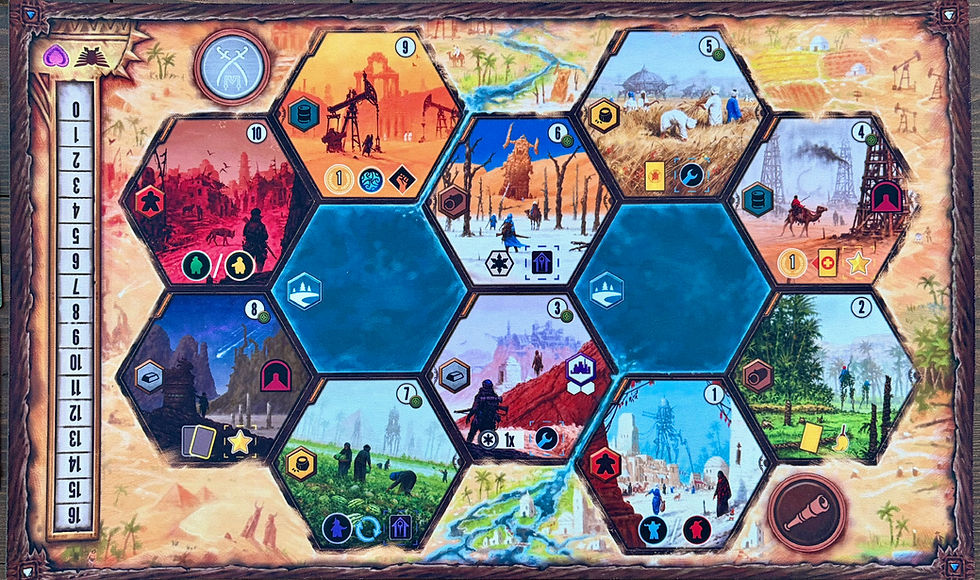
The game takes place on a compact board containing only ten locations and two lakes. Both sides of the neoprene mat have different layouts, changing routes, access points and likely areas of conflict. The smaller battlefield keeps both players close and makes every movement important. Players alternate turns, but each follows the action structure of their respective game. Scythe chooses a section of its player mat and performs the familiar top-row action, bottom-row action, both or neither. Expeditions instead moves its action token to perform combinations of moving, playing cards, gathering or refreshing. Both exactly the same as the original games they are based on.
The shared board supports both rulesets without forcing them into one system. Terrain, rivers, resources and the Factory matter to Scythe, while numbered locations, corruption and Gather benefits belong to Expeditions. It looks busy initially, but each player soon filters out the information that does not concern them. You focus just on what matters to you, and the matrix comes into complete clarity.
The game ends immediately when someone places their fourth star on the Triumph Track. There is no final scoring, no popularity multiplier and no broad Expeditions point tally. Everything is focused into one direct and increasingly urgent race.

The Triumph Track
The Triumph Track is the heart of Duel of Meloch. Each side has different requirements for placing stars, but every Scythe objective is paired against one belonging to Expeditions. Once either player claims a category, the linked objective becomes unavailable to their opponent. If you are collecting Encounter tokens to try and get that star, and the other player claims it first, you are out of luck!
The Scythe player may be trying to deploy all four mechs, complete upgrades, control enough territories, or reach a particular level of power, while the Expeditions player might instead chase workers, corruption, guile, solved quests, or developed cards. You are therefore always watching your opponent rather than quietly progressing along a separate track. They are different goals, but on a shared Triumph track with only one space for each star.
An objective may not suit your current strategy, yet pursuing it can still be worthwhile if your opponent is close to claiming the paired category. This creates excellent moments where you abandon the most efficient action to deny something more dangerous. The race becomes as much about timing and disruption as personal progress.

The two sides also place stars differently. Scythe claims one immediately upon meeting its requirement, while Expeditions usually needs to complete the condition and then use a Boast action. Combat is the main exception, allowing Expeditions to place that star immediately after winning. This gives the Scythe player the ability to accelerate suddenly. A player may appear behind before completing several developments quickly and placing stars across a short sequence of turns. The visible score does not always show how close Scythe is to victory.
Every game I have played has ended with a margin of one star. The winner reached four first, but the losing player was always close enough to believe another turn might have changed everything. That creates tense finales where every action feels dangerous. The Meloch cards work brilliantly here. They help keep the race close by rewarding the player whose opponent has just placed a star. The trailing player draws a card, chooses its orientation, and gains the benefits facing towards them, which may include power, coins, or workers.

Does Scythe Have An Advantage?
Duel of Meloch feels balanced enough to create a close contest every time, but Scythe has won more often in my experience. I would not call the game fundamentally unbalanced because the margins remain so small. However, I do think it leans slightly towards Scythe when both players are similarly experienced.
The clearest advantage is star placement. Scythe claims objectives immediately, while Expeditions often needs another action, the correct location or its special ability to Boast. In a race to only four stars, that extra step can easily decide the game.
Combat also favours the Scythe player, because when using the Expeditions character, you will control only one mech and may therefore use only one combat card. Whereas, as Scythe, you can bring several mechs and its character into the same battle, potentially adding multiple cards. Expeditions must be far more cautious once Scythe develops a meaningful military presence.

Fortunately, combat cannot dominate everything because only one or two stars are available from fighting, depending on which side of the Triumph Track is used. The Expeditions player also compensates with stronger movement and can cross rivers without the same development Scythe requires. Its mech can reach map tokens quickly and gain their immediate rewards.
Even there, Scythe appears to have the easier associated objective. Expeditions needs more map tokens, while Scythe may claim the paired category after only two encounters, and I have seen Scythe win that race in every game so far. The Expeditions player still gains the token benefits, so those actions are never completely wasted.
Corruption creates another difficult decision because the included mech may spend it to Boast, Meld or Upgrade. Those actions are extremely useful, but every spent token makes the corruption objective harder to complete. You are constantly choosing between long-term progress and immediate momentum.

Combat And Control
Combat matters more here than in a standard two-player game of Scythe. The smaller map forces both players into each other’s path, while a battle may award one of the four stars needed to win. Even players who prefer to avoid conflict will struggle to remain separate for long. I have seen many games of Scythe run without much combat, if any. Here, there is always at least one battle.
Sharing a location does not automatically start battle. Scythe must finish a movement action alongside the Expeditions mech and choose to attack, while Expeditions initiates combat through Vanquish. This gives both players some control over when confrontation occurs.
Players secretly choose how much power to spend and may add combat cards, with the attacker winning ties, just like in the original Scythe game. Those cards can also be discarded outside battle to gain a separate benefit printed in the corner. That dual use creates good decisions between immediate utility and future protection.
The system still favours Scythe once several mechs are deployed, but the advantage usually shapes movement rather than deciding the whole game. Expeditions may change route, abandon a location or delay an objective simply because Scythe is nearby. The threat of attack often matters as much as the battle itself.

Scythe And Expeditions, Only Faster
Scythe is one of my favourite games, but its standard two-player experience has never shown the design at its best. The original board is large enough for both players to remain apart, reducing pressure around territory and combat. Duel of Meloch fixes that by shrinking the battlefield and making every objective directly competitive.
The Scythe side feels sharper as a result. Its familiar engine remains intact, but every development has a more immediate purpose because it advances a star, denies a category or threatens the opponent. It reaches the interesting decisions far faster than full Scythe.
This is not better than Scythe for me because the original offers a broader strategic arc and a stronger sense of developing an entire faction against others trying to do the same. However, Duel of Meloch captures enough of that experience to feel remarkably satisfying in around 45 minutes. That is a significant achievement.
Components And Presentation
The production is excellent, with excellent miniatures, clear cards and attractive wooden pieces throughout. The new Constantinople faction fits naturally into Scythe, while Voyager, Nikte and Nohoch look entirely at home in Expeditions. Everything reaches the polished standard expected from Stonemaier Games.
The double-sided neoprene board is particularly striking, with Jakub Rozalski’s artwork providing the same mixture of nature, machinery and unease found across the series. Both layouts offer meaningful variety by changing routes and tactical pressure points. This is not simply the same battlefield with different scenery.
However, my mat curls when one particular side is used. Despite repeated attempts to flatten it, the edges still lift enough to be distracting during play. It may have benefited from being slightly thicker or heavier.
That is my only significant production complaint. The iconography is clear, the box is well organised and much of the new material can also be used in Scythe or Expeditions. Existing owners therefore gain more than a single standalone duel.

Replayability
The two maps and double-sided Triumph Track provide useful variety before any outside content is added. Different objective pairings change priorities, while each layout alters movement and likely points of conflict. Repeated games should not follow exactly the same path.
Existing Scythe factions and player mats can also be imported, while Expeditions owners may use different mechs, characters, companions and many original discovery cards. There are even variants for Scythe against Scythe, Expeditions against Expeditions and tournament play.
As a purely standalone product, another Scythe faction or player mat would have strengthened the package. Expeditions gains natural variety from its cards, while the included Scythe setup may become more predictable.
Pros
Both sides genuinely feel like their parent game while playing in around 45 minutes.
The contested Triumph Track creates tense decisions and consistently close finishes.
Strong interaction, dramatic comebacks and meaningful combat keep both players involved.
Excellent production and compatibility provide substantial replayability.
Cons
Scythe appears slightly favoured, particularly in combat and star placement.
Expeditions has a smaller card market and a harder route to converting progress into stars.
Both players need prior knowledge of their chosen system

Duel of Meloch Board Game Review: Final Thoughts
Duel of Meloch should feel like an awkward collection of incompatible parts, yet it becomes a remarkably cohesive two-player game. Both sides retain the identity of their parent design, while the shared map, contested objectives and combat system create enough common ground for a proper duel. The final result feels focused rather than compromised. Scythe builds an engine, develops a faction and places stars with increasing efficiency. Expeditions explores, manipulates cards, clears corruption and adapts to a more tactical puzzle. Both feel authentic, which is far more important than the novelty of seeing them together.
The balance appears to lean towards Scythe, but every game I have played has remained extremely close. Expeditions is easier to learn but harder to master, while Scythe can turn progress into stars more efficiently. Those differences create tension rather than ruining the contest.
For me, Duel of Meloch is better than Expeditions and only slightly behind Scythe. Its rapid setup and shorter playing time mean it may reach the table more often than either parent game. That is perhaps the strongest recommendation I can give it. Duel of Meloch compresses two substantial games into one small battlefield without losing what makes either compelling.