Search Results
Search this site
727 results found with an empty search
- Outrun: Card Game Review
Outrun WBG Score: 6/10 Player Count: 2-6 You’ll like this if you like: Jungle Speed, Taco Cat Goat Cheese Pizza, Galaxy Trucker. Published by: Good Looking Richard Designed by: Ian Barrow, Paul Hunter, Szymon Stuglik OK, before we start. Let me clear up what we are talking about. This is not the classic Sega arcade game from the 80s. Many of us have fond memories for this classic retro racer. For me, it was watching my old man flock straight to it every time we headed to the arcades on holiday in South Wales. I am not sure what pulled him in. The chance to drive a red sports car. The kicking 80's soundtrack. Or maybe just the occasional passing identical palm tree made him feel like he was on holiday in a far exotic place other than rainy New Quay. But no, this is not that! This is a new card game. Nothing to do with cars, arcade games, or my dad for that matter. Outrun is a fascinating fast-paced real-time card game that creates a true sense of tension. In what is essentially a dexterity-based race-game, Outrun brings some news ideas to the table, in a delightfully B-Movie style theme. In Outrun, your mission is to literally outrun your monster of choice. Well, not literally, in card form. But there is a race! The game comes with four different monsters to set up against. All offering a completely different, and independent game. Bears, Zombies, Vampires, and Dragons. Although, you aren’t really trying to outrun the monster. That may not be possible. But you certainly should be able to outrun one of your friends! This is a game that seems to be based mostly on the classic joke about not ever needing to out run a bear. Just outrun your slowest friend. To set-up the game, give each player the nine movement cards set for their character and away you go! There are 48 path cards in the game. Each one showing a different route you can take to try and outrun your fellow hero’s. The routes show different symbols, represented on the nine movement cards you have. The idea of the game is that you need to sort through your nine cards, find the right symbols and place them face down in the order of the movement card as quickly as you can. Once you have done this, you must place your ‘finish’ card down in the center of the table. Once each player has done this, one person will check the cards have been placed in the right order buy each player and declare the points for that round. The first person to complete this task correctly will be able to move their character piece the most spaces away from the monster. The number of spaces will be dependent on the monster you are facing and the number of players in this round. Once the path card is turned over, this game becomes a simple race of hand-eye coordination, card sorting, and keeping cool under pressure! The task itself it relatively easy. But doing this at the same time as your friends, when your brain is screaming at you “they are going much faster than you, go faster!” is a stressful situation to be in! The player who can keep their cool best will inevitably win the round! All this may sound pretty simple. The real-time nature of the game play wont appeal to all. But the actual mechanics of the game will come across as a little one dimensional! Well, hold onto your monster running away from hats! In Outrun, the Monsters fight back. Interference cards are used by the monsters to make the job of running away from them that little bit harder! Each player will draw an interference card, and can decide if they want to play it against themselves or another player around the table. The interference cards will have multiple affects, but most make the job of escaping the chasing monsters a lot harder, and a lot more fun. There are cards that will force you to lay the movement cards in reverse order, or simply switch the position of two specific cards if they come up. There are some positive ones that let you play one less interference card this round, or discard one. Hence why you may want to keep them for yourself. But most will be more troublesome. Like one where you must switch the second and third card round. So where everyone else will order their cards (for example) Spaceman, Cheerleader, Firefighter, Vampire. You will need to order them Spaceman, Firefighter, Cheerleader, Vampire. Which under time pressure, when up against a real-time competitive situation, can melt your mind! Each monster will bring its own style and flavour to the table as well. The Bear encourages you to play the interference cards against each other to make other players escape that little bit more difficult. The Vampire makes the interference cards affect all players as the Vampire messes with your mind! The Zombie infects players with a virus, thankfully one that you can recover from. Mr. Romero had it wrong apparently. When one player is infected, they can infect other players and each infected player needs to use the special antidote card to remove the infection. Obviously, this is not true to life. We all know the only solution is a double-tap and to move on with your life. The Dragon is my favorite monster to face. In Outrun, when all players have played their cards and their relative success has been determined, the player who acted correctly the fastest will get to run the furthest away from the monster they are facing. Generally, the player in last place does not get to go as far, but they can discard one of their Interference cards as a catch up mechanism. With the Dragon, the fastest gets to move five spaces as the rest are all caught by the Dragon’s fire breath and only go forward one spot. I like this all or nothing rule. It feels a little more dramatic. More tense. More fun. Games of Outrun are fast. You only need to move nine spaces away from the monster to escape, and in turn, win and end the game. Each monster offers you the chance to move three or five spaces if you win the round. And each round only takes a minute max! An entire game could be over in 10 minutes. As such, we like to face off against all four monsters in a row. Or, as you can see from the comments below from Ian, one of the designers on the game, you can daisy chain the escape boards for a longer experience. For what this game does, it does it very well. It looks great, the art is great, and is certainly suitable for the vibe this game is trying to create. The rules are light, simple, and easily explained. The theme is great fun. This game doesn’t take itself too seriously and there is a lot of joy to be had here. However, the experience can feel a little light, and empty of any strategy or the opportunity for clever play. But if you are looking for something fast, fun, competitive, and suitable for a quick romp you will find Outrun offers a lot of laughs. Outrun Website.
- Without A Doubt - Trivia Game Review
Without A Doubt WBG Score: 8/10 Player Count: 2-6 You’ll like this if you like: Any Travia Based Quiz Game. Published by: Shot in the Dark Designed by: Grant Sanderson, Jordanna Sanderson Picture the scene. You are with your family at a big seasonal festive party. You know. JimMas or the such. One person is loving the quiz-based game you are playing. Taking all the cubes, wedges, pizza slices or whatever you call them for themselves and loving all the questions. Even those pesky yellow ones. Who knows about science anyway? I learnt how to turn on the Bunsen Burner without my teacher noticing in my school Physics class. (Although I still just had to google how to spell 'bunsen'). Anyway, you get the picture, right? Most people are not digging the situation. You either know the question or you don’t. And let’s be honest, where is the fun in that? How good is your memory? How good are you at trivia? Is that really a good game for all the family at JimMas? The team at Shot In Dark certainly feel the same. They have a 'smarty pants' dad apparently too, and so decided to create a series of games to combat this. Simply put. A trivia-based game, with answers know one will defiantly know the answer too, but where everyone will have a good time at trying to answer. This started with the seminal Shot in the Dark game from 2019, a Christmas edition (whatever that is) and now, their next major release, Without A Doubt. A trivia-based question game with a very simple addition. Everyone is given a 'Without A Doubt' card to play whenever they are a little more sure about the answer. This will then double their point return if they are right. There are hundreds of questions in this deck of cards. Each one with a clear and simple structure for reading the questions or answers. As such, any player from 8 and up could play this. The questions are accessible enough for anyone to have a guess, and the format of the cards is easy enough for most eight-year-olds to read them out. Let me give you a flavour, if you will excuse the soon to be revealed, terrible pun. What is the best-selling flavour of crips in the UK, Walkers Cheese and Onion or Walkers Ready Salted? No mater your age, your country of residence, or your academic level, everyone can have a guess at that and have as good a chance as any to get the right answer. By the way, if you want to know the answer, you will have to buy the game (or just google it) But the answer may surprise you. Not in the flavour, but the quantity. Its only 1.3 million bags a year, which works out to be 3,561 per day. Which divided by the 60 odd million of us here in the UK, is only 0.00005 bags each a day. Which is clearly nonsense! Right?! (I’m on my third bag of the day so far myself…) Just to show you, this wasn’t a hand selected question to make this game seem different to what it is, I will now draw a random card, and pick a random question to share with you. Here we go… OK, that one was hard, let me try again… What is heavier: an average caravan or an average African elephant? The answer is a 7:1 ratio by the way. Should be easy right? But are you confident enough to play your Without a Doubt card? So, that’s the vibe of this game. With these cards, you can play how you like. In teams. In groups. With points, or without. Perhaps the most point within a time limit? Maybe over dinner, or drinks? Perhaps you would enjoy this over the course of a walk, holiday, or during another game? There is so much scope as to how you can use these cards. And no matter how you do decide to play, I would hope everyone feels involved. Everyone would think they have as good a chance as everyone else playing. There are a lot of multiple choice, 50/50, or just totally random questions, it is hard to swot up for a game of this. Happy JimMas everyone. You can find out more information here.
- The Fog: Escape from Paradise - Kickstarter Preview
What is your favorite game of all time? What was your favorite demo game at Essen this year? What exactly have you done to your hair? These are just three questions that are often put to me. I thought now was the right time to address the important one. I want to look like Aragorn, OK?! Right, with that out of the way. The number one demo that I played at Essen was unquestionably The FOG, a delightfully constructed two-phase game for 1-6 players, set on a mysterious island where an unknown fog is mysteriously making the islanders disappear. I sat down and spoke with designer Robert Müller-Reinwarth from XOLLOX Games at the stand to discuss the design, his ideas for the development of the game, and his hopes for the kickstarter next year. It was clear from playing the game that thousands of hours had gone into the mechanics of the game. It felt incredibly balanced and well thought out. The game starts with the board filled with villagers, all looking to race down the beach to the safety of the boats. In the first phase of the game, players will take it in turns to place their colored discs under one villager. When you do so, you are claiming them as being under your control for the second phase of the game. The villagers at the front will score points quicker, and are often claimed first. But each villager has their own special power, and ones from the middle or back could fight their way forward as the game develops. Once this is done, players will then take it in turns, in a snake draft order, to take their actions in the second phase of the game. Each player has a board with an equal set amount of movement actions available to them each turn. Each action costs a different amount of movement points based on its relative strength. Moving forward one space costs less than jumping, squeezing through two other villagers, or pulling others back and taking their place. Each villager can do all available actions, but they will all have one action that they can do for less movement points based on their own abilities. You can move any of your villagers but have hugely restricted movement points. Lots you want to do plus not a lot you are allowed to do, generally equals a lot of fun tension for me. It is very much the case of this here in The Fog. As the villagers escape the island and walk onto the boats, there will be certain seats that will score more points. Where you sit on the boat, which boat you are on, which villager you are embarking, all these factors will contribute towards the total points available. There is a race element strongly present here, where you will want to get certain villagers to certain seats first. It is not always about what the best thing to do, but what you think you may need to do before it's too late! All the while, the fog is ever advancing. All villagers at the back of the beach are at risk of being taken. After a few rounds where you will feel invincible, the fog will move forward. Any villagers still within this row are out of the game. You will score minus points for each one of your villagers still stuck back here. The minus points are big! And after the first time you are caught out, you will work very hard to try and avoid this happening again! During this second phase, there is a delicate balance to be found between moving your villagers forward into the most profitable seats on the boat, whilst not neglecting anyone trailing at the back. With such limited movement points, and so little time before each advance from the fog, there is a brilliant sense of urgency and tension as you try to prioritise and strategise the best way to maximise your points and move your villages forward. Through the entire game, you will feel like every decision is critical. There are no 'down turns'. You are always thinking about what you should do and trying to figure out the puzzle in front of you. Other players can and will affect your turn, but this is not frustrating. The theme oozes out of this game. In a situation of villagers fleeing for their lives, do you really think you will have things your own way all the time? The game starts with various obstacles randomly set-up to block your villagers path. These all do the same thing, the differences are purely aesthetic. But the prototype components are gorgeous and I want them for my dungeons and dragons! I think I would enjoy playing this game over and over. The game won't change that much each time, but the tension and challenge set by The Fog would be enough to make each game fun, and make you come back for more. This is a game that works simply as it is good. No gimmicks. No extended campaign mode. No real narrative. All the things that usually attract me. But the theme is fantastic and well through out. The art is gorgeous.But the star of the show here is the game play. It's just a great game and one I cannot wait to see more of when it comes to kickstarter soon. You can follow the progress here.
- Boba Mahjong Card Game Preview
Boba Majong is coming to Kickstarter in 2022. I was able to get an advanced preview copy from the Sunrise Tornado Game Studio stand when I was fortunate enough to meet their charismatic owner Ta-Te Wu. I was very interested in the back catalogue of games from Sunrise Tornado, and my interest was peaked from the cute box art and simplicity of play of Boba Mahjong. I love RummiKub, and all card games where you are creating sets and runs. This harks back to my days playing Canasta with my family as a child. So, I was keen to try this, especially as it was billed as a two player only game, which I always like. Boba Mahjong plays very much like other game where you are creating sets and runs, but with a few interesting twists. In the deck are 48 cards. All beautifully illustrated with different ingredients used within a Boba drink. There are 12 toppings cards with options such as Green Beans, Grass Jelly, and Cheese Foam. And 36 other ingredients cards, set across four different flavours running from Zero to Eight. Butterfly Tea, Matcha Tea, Taro Tea, and Strawberry Tea. To play, each player is dealt five cards. Three cards are placed face up into three separate 'Mixing piles. On your turn, you will draw two new cards or one card from one of the mixing piles. You can then create a set using a minimum of three cards from your hand. A set can either be cards in a sequential order, usually called a run in other games. Or of at least three cards of the name number. You can use the Zero cards as wild for either sets or runs. A set can also be three toppings cards, used as three of a kind. Once the set or run has been made, players will then chose one of the cards in the set or run to keep. All other cards must be placed into one of the three face up mixing piles. The cards you keep are how you score at the end of the game. The round ends when the deck is exhausted or one player has five or more stacks of score cards in their tableau. At this point, each player will choose up to six cards to use for this rounds scoring. You are scoring for freshness, smoothness, complexity, and presentation of your drink. Lets look at each one. Freshness: If you have a pair this will bring you three victory points. Three-of-a-kind gets you six points. If you have four numbers all the same, (but different colours), this will get you ten points. Smoothness: This is how you score your runs. Three sequential numbers gets you two points. Four will get you four points. A run of Five will be eight points, and six cards in a run will be 13 points. Complexity: This is how you score your toppings. Each one will get you two pints each. However, three toppings scores seven points. This is the max you can have. Presentation: Three cards of the same colour will get you three points. Four will be six. Five will be nine and six will be 12. You can also score from having different colours. Any four different colours will get you three points. If you collected all five then this is worth five points. The clever part of the scoring is that you can use cards multiple times to score with. For example. If you had a final hand including a green 1,2, and 3. This would score you two points for the run, your smoothness. But also three points for the colour, you presentation. This is the main difference here with this game to others that use runs and sets. Being able to create multiple uses for each card, and multiply each cards scoring potential is a fun and interesting puzzle to solve as you play the game. Once you have calculated your score, you will round that down to the nearest five and take a victory token for each five points you got. The game ends when a round ends with at least one player with six or more tokens. The player will the most tokens wins. Playing Boba Mahjong is quick, and a lot of fun. If you are a fan of games where you create sets and runs, you will love this. It has enough of a difference to make it stand out. The first being how each card can be used multiple times in the end round scoring. The second being the multi-layered way in which you get the cards. A run or set is needed to get the card, and then that card will be used with others to create more runs or sets. I really enjoyed this process. It made me feel involved thorughout. I was not simply creating sets or runs and moving on. Doing one thing to get something else to then use as a resource to do another. thing. It feels a little Euro in parts! Although this is not a Euro game at all. Don't get me wrong. This is a set-collection card game, distilled into its purist form. But the process you go through is quite interesting and feels a level above the 'norm.' The art and theme are wonderful. I love the design of each card, and the idea that I am making the perfect tea. My children love going to shops that sell these drinks when we go into London. And we are huge fans of RummiKub as a family. So, this theme, mechanic, and well oiled gameplay was a huge winner for us. Anyone looking for a quick, light, but fun two-player card game will be very happy indeed with Boba Mahjong. I look forward to seeing the full and final version at kickstarter. I will add a link to that here when it is live.
- The Crew: Mission Deep Sea Video Run Through
The Crew: Mission Deep Sea is the much anticipated squeal to The Crew: The Quest for Planet Nine. In this short 1-minute video I will run through the set-up, rules and mechanics of this fantastic cooperative trick-taking game.
- Fangs Video Run Through
Fangs is a new social deduction party game from KOSMOS. In this short 1-minute video I will run through the basic rules and gameplay.
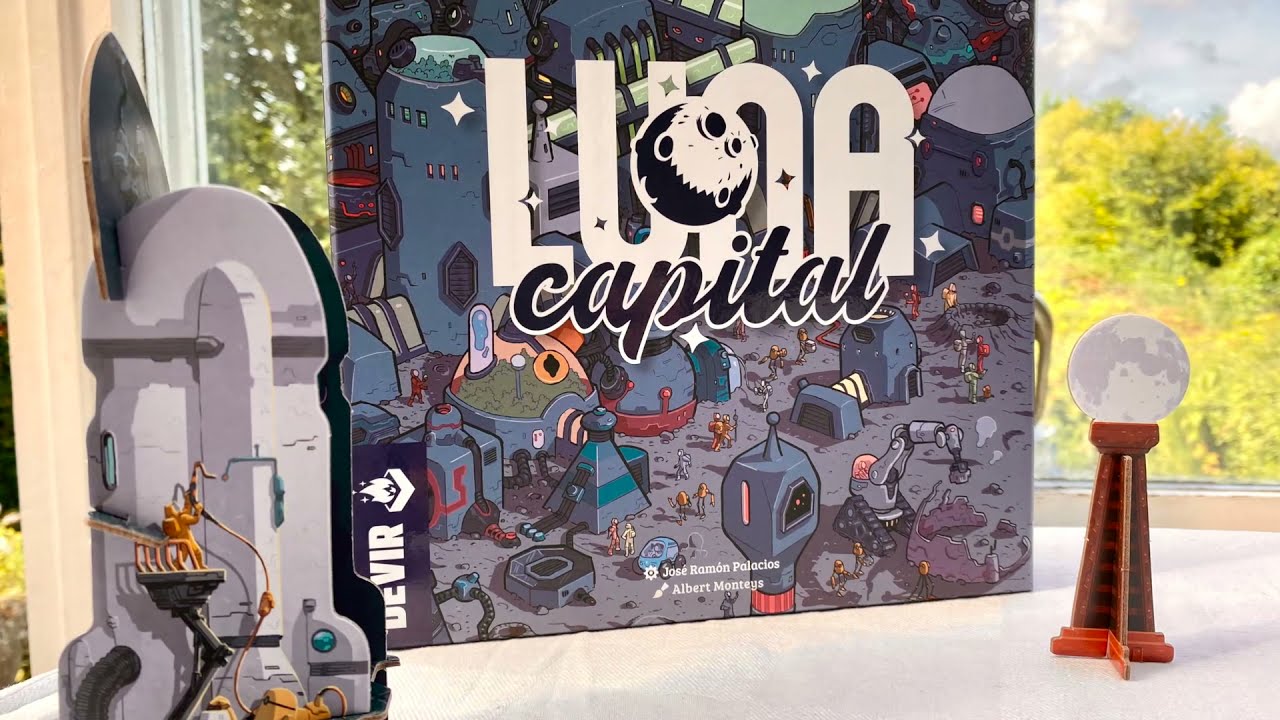
- Luna Capital Video Run Through
Luna Capital is a fantastic new tile placement tableau building games from Devir. In this short 1-minute video, I will run through the basic rules and mechanics.
- Furnace Board Game Review
Furnace WBG Score: 8.5/10 Player Count 2-4 You’ll like this if you like: 51st State, Wingspan, Terraforming Mars. Published by: Hobby World, Arcane Wonders Designed by: Ivan Lashin Furnace, or as its full title on the box more accurately describes, ‘An Engine-Building game by Ivan Lashin: Furnace.’ This game sells itself right off the box. This is an engine-building game. If you are a fan of this mechanism, you will most probably enjoy this game a lot. If not, well, there is a bit of an auction and some nice card play, but ultimately… see the box lid. If you build it, they will come. But what is an engine-builder? If you are not familiar with the term, you may well have experienced it in other games. Splendor, Century: Spice Road and Scythe are all hugely popular games that employ the same mechanic. Engine-Building is the process by which you will develop your powers or abilities in a game by collecting cards, resources or other powers. It is linked to Set-Collection, Hand-Management, Tableau building, and in a way Tech-Trees too; some of which are present in this game as well. But who am I to argue with the box cover? This is an engine-builder, pure and simple. Engine-building games are very popular due to the sense of progression they bring to the gaming table. There is a sense of development. There is a real sense of satisfaction when you get your engine running well. This is felt strongly in Furnace too and is the main reason why I enjoy it. Start Your Engines! The game works incredibly simply. Cards will be placed on the table face up, based on the number of people playing. In turn, each player with then place one of their four numbered Capital Discs onto one of the cards, bidding for that cards power. The discs are numbered one to four, and the highest disc on the card at the end of the Auction round wins that card. But every other player that bid on that same card will be awarded compensation for their failed bid. Each card will have symbols on the top showing you what you will get as compensation. The reward will be multiplied by the number on your losing disc. So, a card showing two coal symbols at the top would reward a player with six coal cubes if they played and lost with their Three Capital Disc. Players can bid on any card available but can never place a disc onto a card where they have already made a bid. Nor can they can ever place a disc onto a card with a number that is the same value as one of the discs already placed onto that card. The winning player will take the card into their play area to use on the second Production phase. In this Auction phase, you will be looking to acquire resources that you need to run your other cards. If you want to win a card that allows you to convert Oil into Money, but you have no Oil, then you need to find a way to acquire some in order to avoid the first cards power becoming redundant. There may be another card that would compensate you with two Iron if you lost the bid for it, and another that would allow you to covert Iron to Oil. Utilising these three cards’ powers would allow you to get your engine going. First, collect your Iron, then convert that to Oil, and then finally sell the Oil for money. This in short is how the game works. It’s Time to Produce. Once everyone has collected their compensation and the cards that they won in the Auction phase, players will then move into the Production phase. All players can arrange their cards into any order they like and then “run” them. This simply means, gathering the resources and making the trades that each card allows you to do. The order is crucial. It may be that you need a particular resource before you can achieve a certain goal, and that first resource you need will be made available to you by one of your other cards. As such, you must ensure that you place this resource producing card before the resource exchanging card. The game will run for four rounds Each time running through the Auction and then Production phase. The goal being to collect as much money as possible. Any resources that you are left with are useless at the end of the game. You want to avoid running an engine that over produces a resource that you cannot then use for something else. This game is all about efficiency. Getting cards to work together in harmony for the ultimate aim of money! In a tie situation, the player with the most cards will take the win. If there is still a tie after that, then it will be the player with the most resources. But this very simple tie-breaker rule shows you how the game should be played. This is about having cards that work for you. Not just cards that make lots of resources. It’s Alive! Each player will be given a starting factory and unique player power at the start of the game. This small amount of asymmetry brings another side to this game that will increase its replayability. Each of the five available character cards offers something quite unique such as one extra disc with the value of two to use in the Auction phase, or the ability to break the Capital Disc placement rules. Your engine will not just be about getting the right cards. This game will also ask players to upgrade their existing cards. All the cards are double sided and offer additional benefits on the reverse side. Winning some cards may only be the first step. Flipping them could be your only chance of victory. There is also an advanced variant which I enjoy, but perhaps is not suited for game one whereby players cannot rearrange the placement of the cards once they have them. New cards must simply be placed to the left or right of any existing cards. This makes players think a lot more about what they bid on from rounds two onwards and creates a much more challenging game experience. A Well-Oiled Engine. There may be times of frustration when you cannot get the card you want. It simply may not turn up or it may be that you win it when you just wanted the resource. Or you only get the resource as compensation when you wanted to win it. But this is the nature f a competitive game. It won’t always work out exactly as you plan. Running an efficient engine in Furnace is a very satisfying experience. Win or lose, if you create an engine that is running smoothly, and churning just the right number of resources you need to convert into money; you will be left with a huge sense of achievement at the end of the game. Engine builders are popular for this reason, but often the mechanism is buried within a much more complex rule structure or mixed in with other mechanisms. In Furnace, the engine building is the entire game. There is the interesting auction mechanic in which the cards are acquired, and the clever idea for compensation for any losing bid which makes this part of the game a lot of fun too. But ultimately this game is boiled down to the engine-building. Get cards. Make them work together. It sounds simple because it is. But to play it, you will feel utterly engrossed in the process. Games don’t always need multiple mechanisms to be fun. If you like engine-builders, or like the sound of it and want to give it a try, Furnace could well be the game for you.
- Rolling Realms Roll-and-Write Game Review.
Rolling Realms WBG Score: 9/10 Player Count 1-6 (more with other copies or print outs) You’ll like this if you like: Ganz Schon Clever, Riverside, Hadrian's Wall. Published by: Stonemaier Games Designed by: Jamey Stegmaier It’s the end of March 2020. Lock down has just begun, and people are starting to feel isolated. For the publishers, group play-test sessions to develop new games become a thing of the past. But video calls opened up a world of opportunities for game developers to play with gamers all over the world in mass numbers. Jamey Stegmaier from Stonemaier games, due in part to the changing world around him, and I imagine his “always making a game” brain, chose this time to bring the world, ‘Rolling Realms’. A free to download, infinitely scaling, one page print out, roll-and-write game. Jamey took to Facebook live to offer rules explanations and play-throughs for people stuck at home. It gave people the opportunity join in with a live game and find some human contact. I for one found great solace in this and would like to thank Jamey for what he gave to the community. In each session, the game developed, with new rules, tweaks, and developments based on the feedback Jamey received from the playing public. A mass play test was being done live in front of all our eyes. Jamey never had the intention to publish the game, this was just some fun, and his way of giving something back to a separated community. You can still download this free version here or play via a web link here. All you need is dice! As the weeks went by, the game continued to develop, and eventually got a new name. ‘Rolling Realms’ became its final title after someone who played along with the game suggested it to Jamey in the live chat. This truly was a community project. The game was well into its later stages of life, now in its tenth and eleventh version. Fast forward a few months and Jamey put a message out to his email subscribers asking if anyone would be interested in a full published version of the game. The response was positive and here we are. A full printed version of Rolling Realms, with massive dice, beautiful pens. All the usual Stonemaier gloss! (except of course the matte rule books) Dice shown with a regular sized dice from Rory's Story Cubes, Adventure Time, for scale and general awesomeness. Now, with the final version of the game hitting retail, it's a strange feeling seeing, touching, and playing a game that existed only in home made printed form before, and meant so much to me and so many others during that strange time back in lock-down. Now in full Stonemaier final production form. I was unsure if this needed a published version. I was unsure if I wanted it. The well used, creased, old print-outs offered some sense of comfort to me. The print-and-play version was effective, elegant, and fun. But with this full version of Rolling Realms now in my hands, I can safely say I am so happy this has been made. The game is not more fun in this version. It’s the same game! (although with an awesome solo mode!) But it’s certainly prettier! The pens and dice are so good. It’s hard to explain what difference is made by a good pen, but it’s a lot! It feels more of an event when you play this game with this version. This is a great example of what production quality can bring to the tabletop experience. What a pimp up this has had! Playing Rolling Realms, like many roll-and-writes is great example of the pleasures gained from cascading turns. If you have not come across this term before, what I mean by this is that as you build up your resources in the game, your abilities to take multiple turns increases. Doing “A“ elicits the opportunity to do “B”, which in turn could mean you can do “C“ too! Cascading turns are very satisfying, and any game that uses this mechanic well is always a winner for me. It feels like you are being more efficient. Taking multiple turns instead of one. Feeling good during games is a number one priority for me. Cascading turns is a great way for everyone to feel good! In Rolling Realms, each player is given 11 realm cards. Each realm represents one of the other Stonemaier games. I wish their was a Rolling Realms realm card. Although that could be a bit Inception. One player will shuffle their cards and draw three to play with. All other players must then find those same three cards to use so each player has the same three cards ready for round one. Each realm works slightly differently, but they can be easily explained using the rule book, and have clear and simple rules printed on the card themselves. Even on game one, you will be up and running within a few minutes. Each player will also be given a resource and score card, a pen, and eraser pad. One player will then roll the two dice and the game begins! But before I get into that, a word on the dice and pens. Even if you haven’t played many games that use dry wipe pens before, I am sure you will be able to feel the difference with the pens provided in this game. They feel comfortable in your hand and write well with a nice fine (but not too fine) tip. The pens leave a nice solid dark line wen used. Not that washed out faded line so many others give you. It's just a pen, I get that, but it feels nice! It feels Stonemaier. Now, onto the dice. They are huge! Jamey originally wanted to have even bigger ones, but felt they didn’t roll that well, and could cause damage to some people tables. Being in possession of my own giant D20, I can vouch this is the case! So, in effect, this is as big as dice can get without those two real issues becoming a problem. That’s a comforting thought, isn’t it? OK, onto the game! You will roll the two dice nine times, each player uses the same dice faces shown each round to activate two realms. You cannot use both dice for the same realm card. You will then draw three more realms from the remaining eight realms and go again. Rinse and repeat one final time with three more realms from the remaining five and then score your total points. To see how each realm works you can check the full rule book or you can play along with Jamey here. But I will go through them briefly to give you an idea. Each realm has a style and theme that follows the Stonemaier game that it‘s named after. All-be-it in a very light way! The idea being that you are rolling dice through all the realms created within the Stonemaier universe. Between Two Castles. In this realm, players are looking to place die values in columns, ensuring each die is below a number of a lower value. Each completed row will gain you resources. Each column completed across each individual castle will gain you a star. This is a nice simple realm and a good one to start with when teaching the game. It is also a good realm to explain about using your bonuses seeing as there are ten spaces to mark a number and only nine rounds to do so! Charterstone Charterstone has a fascinating way to use the dice. There are spaces, laid out horizontally to mark each possible dice face from one to six, each one gaining you a resource when you do. There is a crate shown under each dice symbol. In this crate you must mark whatever dice face was shown on the other die, the turn you mark the number above. Ideally you want to mark the top row number when the other die shows the same number as a previous round when you also activated this realm. This is because in order to gain stars, you must mark off the bottom row crates with a dice face that matches one of the numbers you placed here; and you can mark more than one crate per turn if the numbers there are the same. For example, if you marked the six when the other die showed a one, you would put a one in the crate below. If when you mark off the three and four, the other die face again was a one, a one would noW appear in three crates. If on a later turn, one of the die faces rolled shows a one, you can use this one to mark off three crates and gain three stars in one move. Between Two Cities This is a simple one, probably the simplest in the game. There is a three-by-three grid which must be filled with numbers. Each number can go anywhere, so long as it doesn’t touch a number of the same value in the space alongside, above or below it. When each row or column is completed, you are rewarded with resources. And this realm simply scores the same score as your lowest realm from the other two that round. This realm is about gathering resources to help you in the other realms. Euphoria This realm shows die faces of one to six two times in two separate groups. When you mark one number off you will gain a resource depending on the total of each dice face marked off in that group. For a total value of one to three you will gain a coin. From four to ten you will get a star. Anything above ten will get you a pumpkin and a heart. Marking a four, then one, then two, in three separate turns, will gain you three stars each round, as each time, the total value was within the four to ten range. If you can do this sequence twice you could complete this realm in six turns. My Little Scythe Like Euphoria, My Little Scythe shows two sets of dice faces from one to six, this time in a flower shape. When you mark the left side you will gain a pumpkin, on the right you will gain a heart. When you mark off a number on one side that has had the same number marked off on the other already, you will also gain a coin. In order to gain stars in this realm, you must gain any six resources through any of the three realms active this round. Each time you do this, you will gain two stars. Like Between Two Cities, this is a resource building realm to help you on other cards. Pendulum This is by far my favorite realm. It has a very clever mechanic that you must not let run away from you. There are three sand timers shown, each with a dice face shown in them. One with just a six die face shown, another with a five and a four, and the third with the one, two, and three. Above the timers are five octagons full of resources and stars. When you roll any dice, you can mark one of the hexes (or should that be oxes? Later, when you mark the numbers in the sand timers, and complete all numbers in each timer, you will gain all the resources marked in the octagons above at that point. If you don’t get this done soon enough you will quickly fall behind. If you completely mark a sand timer before two stars are marked, you will not be able get all six stars. If you wait too long to complete the timers you will run out of rounds to score the full stars. It’s a delicate balance of timing, and I love it. Scythe This realm shows two rows of die faces from one to six, each with a resource next to it. The top row will gain you the resource marked; the bottom row needs the shown resource to be spent in order to mark it complete. The bottom can be marked at the same time as the top. Ideally, you want to mark the bottom row in the round you are marking the top row and when you have the required resources to be as efficient as possible. As such, you don't want to use this realm in the first round. When both top and bottom row spaces are complete you will gain a star. Tapestry This is the realm I struggle with the most. There is a six-by-six grid shown, separated into six by two rows and columns. Each die face offers a different polyomino shape which can be used to fill in the grid. Each two-by-two square completed gains you a resource. Each two-by-six column or row gains you a star. The higher number shapes are bigger so you would think it's best to use these to fill more spaces, but it will need a few lower numbers to fill the gaps. This is a clever little game in itself, but the one I seem to struggle the most with. The Society (Red Rising) This is a called The Society due to Red Rising being an IP and one that is not free to use in this game sadly. This realm has the simple task of noting numbers in nine spaces in three rows. One row of four, one of three, then one above of two. Each card must show a number that is higher than the number below, representing the elitist nature from the book. When you complete a row you will gain a bonus. When you complete a pyramid of two cards below one card anywhere on this realm you will gain a star. This will be enough to get five stars. The final star is gained by filling all nine squares, meaning this realm needs to be activated each round for full points. Viticulture There are six grapes shown on this card. They are numbered one to six, and you may mark one with the corresponding die face and gain a bonus. Below the six grapes are three wine glasses numbered ten, eleven, and twelve. To mark these and in turn gain two stars each time, you must use one die face rolled that round and one previously marked grape to equal the total shown on the glass. This realm could be completed in six turns, if you roll a lot of sixes! Wingspan This realm shows three bird cards, each with a value inside. There are also three boxes to be filled within each bird card. When you mark a number from a corresponding die face in the box, you will gain a resource. You must mark them from left to right, but on either of the three cards. When you mark the third and final box in each of the three cards you will gain a star. If the three numbers you marked in the card total the exact same value as the card itself you will gain another star. This realm needs to be marked once per round. We spoke a lot above about the resources. Using these efficiently is key to scoring well. In Rolling Realms there are three resources. Pumpkins, Hearts, and Coins. Each can be used in two different ways. Players can use two Pumpkins to adjust a die face by one, just for their own personal use. Three pumpkins will allow them to adjust the die face by one and use that die in a realm in which you have already placed a die that round. This is the only way this rule can ever be broken. This is a powerful tool for completing the realms that need nine or ten numbers. If the dice rolled are a pair, then two hearts will allow players to use the value of the dice three times, one in each realm. Three hearts allow you to reuse one of the two dice in another realm when they are not a pair. Coins are the most powerful resource, I think. If the sum of the two rolled dice is seven, such as a four and a three, five and two, or a six and a one; then two coins will allow you to gain an extra die of the same value as either of those rolled die to use in one of the realms that round. But you can also use coins another way. This is a key tactic for getting good scores. For one coin, you can gain a die to the value of a one, or for two coins, you can gain a two die. Etc. You cannot place this extra die in a realm you have already activated that round, but this is a great way to boost your score and achieve the realms that require a die to be placed in it each round. This full published version also has a fantastic solo game. This is set over an 18-hole mini golf course! The idea being that for each hole, there is a unique challenge you must try and complete. I don’t want to spoil this for when you come to play. I really enjoyed learning each one as I went. But to give you a flavour of the mechanics, I will talk about hole one. This hole requires the use of Charterstone, Scythe, and Tapestry. There are only seven turns this round. Two less than the usual nine. Your goal is to score at least eight stars, or nine and a half on hard mode. This is a very simple rule change, but not overly easy to achieve. The later holes have a similar set-up of three cards being used (except the last hole), a rule change each time, and a specific goal. But I will leave you to find that out of yourselves. But what I will say is that it gets progressively more difficult! But I have really enjoyed the challenge and won’t stop until I have competed them all! Overall, this is a very interesting project. I loved the print-and-play. The concept behind this game’s conception is beautiful. The final product is fantastic and takes it all to a new level. Within it's genre of roll-and-writes it must score very highly. As a project within the community, it must score extremely well. And as a stand-alone game within the wider world of all the choices we have, again, it must score right up there for me. My score above represents all this. Rolling Realms is a great game and one that has a story and history that adds to the experience. But the game on its own, played fresh by someone naive to all that came before, will still find it brings a great experience to the table.
- Zombie Teenz Evolution Family Game Review
Zombie Teenz Evolution WBG Score: 8.5/10 Player Count 2-4 You’ll like this if you like: Zombie Kidz Evolution, Ghost Fightin’ Treasure Hunters, My City. Published by: Le Scorpion Masqué Designed by: Annick Lobet This is a spoiler free review. In the final section, there are some very minor spoilers that are hard to read unless you highlight the text, but you can stop at that point and have all the info you want if you don’t want any spoilers. Did you know that Zombie Kidz Evolution is the number one family game according to Board Game Geek? Well, the developers behind it have launched a sequel and it is always number two in the family list! Zombie Teenz Evolution is a stand-alone sequel to the amazing Zombie Kidz Evolution. It is a legacy game suitable for children from five and up. A legacy game means it has things that happen in the game that permanently change future games. New rules, characters, and powers will unlock after meeting certain requirements or hitting a certain goals. These changes will be in the game forever, replacing something else for good. Legacy games are great for encouraging further games. It is hard with Zombie Teenz Evolution to ever just play one or two games! The way the game develops is through opening envelopes. After you meet certain goals playing the game, you can open an envelope. Inside these box of delights could be… well, who knows! And I won’t tell here! This is the joy in this game. My children go crazy for this! They love the carrot this dangles for them. They absolutely adore opening the envelopes to see what is inside. This becomes the bigger attraction with that game than playing the game itself! The whole game is explained in a comic book style rule book which develops over time as you open more envelopes and get more parts of the story to add in. The highly visual way of learning works brilliantly for younger players and makes this game accessible for children to play alone as well as with parents. The game works very simply and is designed for younger gamers to play with full confidence and control. Like Zombie Kidz, you need to move your character around a board, trying to complete certain missions. In Zombie Teenz, the mission is to collect a box of ingredients from four separate buildings and bring it back to the school. You cannot carry the box, but you can pass it one space if there is another character next to you. On your turn you can carry out two actions. Move a space, pass a box, or fight a zombie. You can do the same action twice if you like, and as the game develops, more actions will become available to you. But the fundamental game remains the same for most of the game. Each game takes between 5-10 minutes to play, as such, and due to the repetitive nature of the game-play, this is ideal for younger children to play and feel in complete control. This is not a co-operative game where you as the parent need to tell them what to do all the time. The game rewards you win or lose. There is no pressure on you or the children to make the right moves. Later games do get a little harder to win first time which brings its own tension. But each time you play you can add a brain sticker to the back page of the rule book to progress your movement towards the next envelope no matter the result of the game. If you win the game or achieve certain goals, you can add trophy stickers as well as the brain sticker. Winning does speed up your progression through the game. But losing doesn’t stop it. Before you take your turn, you must roll the white dice to see what happens with the zombies. At the start of the game, they are all lined up outside the town. But they will quickly arrive and course chaos! The colour of the dice roll determines which zombie you need to place on the board. If you roll this number again on a later turn, they will move forward along their path. Unless of course one of the players has fought them off. If they move twice then they will enter one of the buildings and ransack it. This is shown by placing a large tile on the board covering the building showing new art. If this happens to all four buildings you will lose. It can start to escalate quickly as once a building is ransacked, the zombies manage to find a trampoline in each room, which then moves them forward three spaces rather than one when they move again, all the way to the next building which in turn becomes destroyed! I would like to now cover some of the developments seen in the game, but I am very keen to not spoil this for anyone who wants to encounter and discover this all for themselves. There is nothing below that will be a major spoiler, but nor is there anything that you need to know in order to understand the game or its key mechanics. FAIR WARNING – MINOR SPOILERS AHEAD - To read it more clearly highlight the text. Works on Desktop only. As you progress through the game and open the envelopes, you will encounter new characters, items to use in you battle against the undead, and new rule cards. Beyond that, I don’t want to say too much as I really want you to experience this for yourself, but I did want to make the point, that although at first this game seems very simple and basic. It does ramp up quickly. It never becomes anything beyond the capabilities for a younger player, but it does stay fresh for all at the table. What I found with my six-year-old daughter was that as the game developed and more options were made available, she did not become confused or overwhelmed, just excited about the new things to do. She did sometimes forget to roll the second dice. But essentially it is a very light game which develops into a light game. As new rules are introduced every three to four games rather than having to learn everything all at once as is the case with most games, Zombie Teenz has a very delicate and simple learning curve suitable for younger players. Playing Zombie Teenz Evolution is a fantastic experience suitable for any family. I would recommend getting Zombie Kidz Evolution first if you don’t have that as it feels like the natural place to start. And then if when you finish that, you are hungry for more, this is the perfect next game. The Zombie theme and art is not scary of inappropriate for younger players. This is an ideal game for children to learning simple pick-up-and-deliver and legacy mechanics in a highly engaging and exciting fashion. When you have opened all the envelopes, this doesn’t stop the game being playable. There are a few surprises left for you to try which I wont spoil here. The main draw is certainly the envelopes, so when they are gone, it does feel completed. But the game can certainly be played and enjoyed many times after this is over. And by that point, with 30-50 games played, you will certainly have got your money’s worth anyway!
- Flourish Board Game Review
Flourish WBG Score: 7.5/10 Player Count: 1-7 You’ll like this if you like: Everdell, Wingspan, Meadow. Published by: Starling Games Designed by: James A. Wilson, Clarissa A. Wilson From the makers of Everdell... is that enough? I imagine that this is reason enough for many to just go and buy this game. Everdell was such a huge hit! But Flourish is a very different game. It has a familiar feel to Everdell. The sense of nature and the beautiful art seen in Everdell still shines through in Flourish. Flourish is much simpler and lighter and plays in half the time. But it is still about creating a tableau of cards to maximise your score. Let's take a look. Flourish is a drafting and set-collection game. It feels surprisingly quick and light when you first play. Understanding the interactions the cards have with each other is crucial to scoring well. This will take a few games. But the rules are very light and you will up and away within minutes. To set-up, place a cardboard fence piece between each player. Give each player a scoreboard, and deal six shuffled cards to each player. The game then starts simultaneously with players drafting one card from their hand to keep and two to pass. In round one, they will keep three cards in all. There are four rounds in total leaving players with 12 cards to score from at the end of the game. When you pass a card, you must chose one to give to the player to your right, and one to give to the player on your left. Placing them either side of the fence next to you. In a two-player game you gave two cards to the other player. You will then pick up the two cards given to you, and take one more card from the deck to draw back to a hand of six. You will repeat this two more times then score the three cards you picked that round. The cards have symbols on the top which are used for mid game scoring at the end of each round. And symbols on the bottom which are used for end game scoring. The cards will reward you with points for certain symbols you have collected in your garden and also symbols in your neighbors area. The final round is played a little more simply where players chose three cards from their hand of five before they draw from the deck; and place them down on the table without a final drafting round. No matter if it is a one or seven player game, as all players are playing at the same time, a game of Flourish will be over within 20 minutes even on your first few games. It is a simple process of looking at six cards and choosing the one you want to keep and the two you are happy to pass to your neighbors. The game has a clever opportunity to be played either competitively, or in a cooperative manner with no rule changes whatsoever. At the end of the game, in a competitive game, the player with the highest score wins. In a co-op game, the players adds their accumulative score and check to see which medal they achieved against the score sheet in the rule book. Both experiences offer a good option, and the choice really just depends on your own personal preferences. All this is enough for me. When I am looking for a quick, light card game, that plays well in any player count, but still offers an interesting scoring mechanism with some engaging strategic choices, Flourish delivers. But perhaps due to the nature of this being a Kickstarter or because of the simple nature of the game, the designers have created a vast number of rule variants and expansions that can be added, all included within the base box. Let's take a look at them all. Garden Show Variant. During set-up, give each player three randomly assigned ribbons which are placed face up for all to see. If there are any duplicates, redistribute until all players have unique ribbons. The game then works as usual, except you will be required to play three consecutive games. All possible in under an hour. At the end of each of the three games, players will see if they managed to attain the goals on any of their ribbons by having the most of the symbol shown on it. If so, you will flip the ribbon over and add seven points to your total. If not, you can try and do so in one of the following games. This is a great and simple addition to make this game longer if that is what you want. I usually play the base game at least twice each time anyway, so this is simply a structured way to do this. But the ribbons are a simple add on with no extra rules that add a focus to each players game. Its a nice way to give newer players something to focus on when perhaps they may be overwhelmed by the choices. Compost Variant. The Compost variant is designed mainly to allow players to cycle through more cards in the deck. One minor complaint seen in Everdell and interestingly fixed in Flourish. It adds one simple rule tweak where after choosing one card to keep and two cards to pass, you can then discard one card and draw two, instead of just drawing one if you wish. This is a good option to give players the chance to see more cards and get a higher score by having more choices, but perhaps not ideal for game one when the choice may overwhelm new players. This will slow the game down a little but only by a few minutes each game. It doesn't seem overly necessary but it is a nice simple addition you can bring in if you so desire. Friends Expansion. The friends expansion utilises the deck of friend cards, where two are dealt at random to each player during set-up. In a co-op game they are placed face up, otherwise keep them secret. At the end of the game, players will score one of their cards based on which ever one has gained them the most points. They are all thematically linked where the butterfly wants more purple flowers,and the earthworm wants more fungi. This adds a nice target and goal for the players to aim for, similar to the ribbons, with no extra rules or time added to the game. The difference with the ribbons being that the players will get the points for the friends no mater what other players do, as long as they have one matching symbol. Whereas the Ribbons are about having the most of a particular symbol and so a more competitive option. Follies Expansion. A folly is a building or structure designed for decoration not purpose. A whimsy. Right up my street! During set-up each player is given one each of the five different follies. They look great, and add some real table presence to the game but ultimately are just an extra symbol that you can add to a card at the end of the round. They can only be placed on one of the three cards placed that round and that share at least one of the same symbols as that of the folly. In a more interesting rule change, with this expansion, for the final round, players can place the three final cards on either row. They no longer have to make up a fourth a separate row of their own. At the end of the game, each placed Folly is worth two points for each symbol matching its symbol on the card it was placed on and each card adjacent. Any unplaced Folly will loose you five points. This is my favorite addition as it changes the game the most. I like the extra challenge to work vertically, not just in the rows per round. Looking to place cards adjacent to the folly adds a new dimension to the game that I think elevates this to a new level. Flourish is a beautiful game and will sell bucket loads for the art and theme alone. But it's also a very good set-collection game in its own right. The options available in the box are a nice option. You can add them all in, or just the ones you like. They work in a modular fashion and give you the chance to fashion Flourish to be played exactly as you wish. The options with the competitive or co-operative game mode are a nice addition and make Flourish an ideal game for many collections. This game will work with most scenarios and with most players. There is a way to play it to suit most gaming groups, and when you do play, I would wager than most players will enjoy themselves. The theme and art certainly sell this to me. But the game play and simple strategic choices will keep me bringing Flourish back to the table.
- Resident Evil 3 : The Board Game - Review
Resident Evil 3 WBG Score: 8.5/10 Player Count: 1-4 You’ll like this if you like: Resident Evil 2, Gloomhaven: Jaws of the Lion, Dark Souls. Published by: Steamforged Games Ltd. Designed by: Sherwin Matthews Before I start, I want to be clear this is a spoiler free review. The year is 1996. I’m a skinny, awkward teenager, with a terrible acne problem, an obsession with football, and a dream of being able to sleep in every day. Then, after I won a PlayStation in a competition at a football match, a friend gifts me his old of Resident Evil as his Mum said he wasn’t allowed to play it! And everything changed! Fast-forward 25 years, and I’m still obsessed by the Resident Evil franchise. Having lost a lot of my youth to the first few games, the name alone inspires many fond memories. But, as someone who is not into painting miniatures, I hadn’t been drawn to any of the board game versions yet. There have been a few iterations over the years, the main ones being the deck-building version back in 2010, then Resident Evil 2 board game in 2019. And recently, a new version of this, Resident Evil 3: The Board Game, which drove 7,489 backers on Kickstarter to fund this update. RE3 is a stand-alone sequel that plays similarly to RE2 with a few minor rule’s tweaks, but a number of new additions for fans of the series. If you don’t own any versions yet but loved the video games, RE3 is the one to get. If you own RE2 already and loved it, in truth, the main addition here will be the new campaigns to play. However, the art is a little brighter after fans complained it was too dark in RE2, and there are of course a few surprises along the way that I am sure will delight loyal fans. But should you buy this if you are not a fan of the IP? The game is set deep in the world created by the video games, and as the great @northern_dice said on the games Kickstarter page, “This board game is a beautiful homage to Resident Evil’s classic survival horror feel.” Something I could not agree more with. So, the question more is this. Do you want a game that brings tension and horror to a dungeon crawl tabletop game? If so, then this should be on a list of considerations. Resident Evil 3 throws you into the world of Racoon City. A fictional American metropolis thrust into a horrific post-apocalyptic world. Your first mission is to escape from a warehouse, onto the streets of the city. This is done is a very smooth way, teaching you the game in the process. There is a lot of intimidation when it comes to buying, learning, and playing a game like this. The large box, thick rule book, and second large campaign handbook. It can put some people off. But I found I was up and playing withing 25 minutes of opening the box. The game recognises this with lines such as “we’re sure you want to jump straight into the action, so let’s not waste any more time!” As such, after a few clearly written pages about the iconography, characters, cards, tiles, enemies, and weapons, you will be up and running. Literally! Trying to escape the zombies. This is the first lesson. Killing zombies in RE3 is very hard. You essentially have a 1/6 chance of doing so each time you try with a knife. Other weapons will increase your chances later in the game, and you do start with a gun which you can fire three times, but you are still looking to roll the single face of a D6 that will cause the enemy you are attacking any damage. As such, you will find that dodging past enemies, shutting doors behind you and all round “just leg it” tactics are what happens most often in this games early scenarios! But that doesn’t detract from game. It just means you need to adjust your expectations. But don’t worry, there will be Shotguns, Grenade Launchers and Assault rifles in your hand soon enough! The game is set-up to make you feel like you are playing a video game. At the start, you have access to three areas of the map. You can play either one as your first game. In each scenario, you will be tasked with collecting the campaign progression path token, which unlocks later levels. This, along with collecting key items and defeating certain enemies will be the main tasks required to success at the missions. It feels very much like progressing through a video game. As you move through the Downtown, Uptown, Commercial, and R.P.D. areas, you will be looking to progress you way through the C item deck. Items are separated into A, B, and C decks. A's are mainly ammunition and herbs. B are scenario specific items needed to get through the level you are on such as specific keys and Weapons required. The C deck is sorted at the start of the game as a tantalising look at what is needed. Players are asked to shuffle the deck in a way that certain cards will come out later in the game, but still at a random order. Attaining the C items is crucial to each rounds success, and without them, you will need to re-do the mission. Setting up each level is very simple. The Scenario booklet clearly shows what is required visually and there is a simple to understand key for each one. Spotting all the Barricades can be hard due to the colours used, but other than that, this is a breeze. The scenario booklet also offers a simple to use guide for the encounter dice. As the game progresses, you will quickly start moving into areas on unexplored territory. When you do this, you must roll the encounter dice, and each level will have a separate guide as to what each die face represents. This is a great system that works well both mechanically and thematically. Playing Resident Evil 3 will most likely come in bursts. I played most of my games in batches of two or three scenarios at a time. As such, you will need to get used to the pack-up and tracking system. If you have the Kickstarter exclusive inserts, this will be a little easier. But I used bags and found it to be quite simple. On the back of the scenario booklet, you can record your item box and character items, but a quick photograph on your phone will do just as good a job. But after a few plays, I just put each characters items into separate bags and found this to be a quick and simple process to set-up from at a later date. The tension deck used on each scenario (bar the bosses), and played after every character turn evolves through the game, as does the item decks. As such, you don't want to mess them up mid scenario. Simply band them together so they cannot be confused with other cards already taken away or not added yet, and you are done. Running through the scenarios is a brilliant, narrative driven, suspenseful ride. I have absolutely loved it. The question many may have, is how much replay-ability is there in the box once you have done this. Well, there are four characters, so you can always try with other people. Also, each scenario plays differently each time based on a number of random factors, so if you enjoyed playing once, I am certain you will enjoy playing again! However, I found, going back to early missions and loosing all my powerful armory was tough to take! But give the game a break for a few weeks or months and I am sure you will be able to enjoy running through them all once more. The game has a stack of expansions out and on the way too. I have the City of Ruin expansion which I will review in a few weeks once I have run through that. I am very excited to see what that brings to the table. But ultimately, like any campaign game, there will be some who will play it once and then not again. It's up to you if it is worth it for that. But I found just the base games 15 missions to be ample experience for this price and box size. The minis are ok. A little small. But good detail and robust. They all come painted a solid red colour, so pop on the board right out the box. The ones I have seen painted online look phenomenal and if I had an ounce of patience for that sort of thing, this would be one of the first games I would do that for. But as someone who love minis but doesn’t as yet paint, these look okay to me. The boss minis have a nice size to them, and the ones in the expansion look incredible! The rest of the components are good. The only complaint is the Raccoon City dashboard which is printed on standard paper. This could do with being a thicker card, perhaps duel layered to hold the elements in place. But the rest of the parts are solid. Good dice. Decent cards. The tiles for the map are beautifully illustrated and surprisingly detailed if you take the time to look at them I have loved my time in Raccoon City. It has been great walking down memory lane. And revisiting my youth. Despite the constant attack from zombies. The game is hugely entertaining full of suspense and ramps up the tension and difficultly very well in my opinion. I have seen some complain of this being too easy, but there are simple ways to adjust the difficulty if this is the case for you. However, I found the difficulty to be just right, especially as I played most of this with my son. The Resident Evil legacy lives on! From a game, to a film, TV series, comics, and even a play in Japan back in 2000! Resident Evil is close to many of our hearts. The games certainly play on this using art directly from the old games and not messing with the winning formula. If you are looking for a trip back to Raccoon City and like the idea of being reacquainted with some old Zombie bashing friends, then I can think of nothing better than sitting down and playing through the scenarios in Resident Evil 3. I absolutely loved it.